Hollywood Land's Five

Hollywood Land's Five
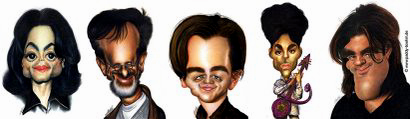
Mickey, Steve, Leo, Dwayne & Toño illustrated by Paddy Boehm

Monday, June 04, 2007

Freddy Krueger Is Back!

Freddy Krueger, full name Frederick Charles Krueger — is the main fictional character from the Nightmare on Elm Street series of films. Created by Wes Craven and portrayed by actor Robert Englund in every film of the series, he is an undead serial killer[2] who can attack his victims supernaturally from within their own dreams when they are in a state of sleep. Freddy is commonly identified by his burnt disfigured face, red and green striped sweater, brown fedora hat, and trademark metal-clawed leather glove. Freddy Krueger’s origin has slowly evolved over the course of the film series. Each subsequent film revealed new information that intertwined with the backstory established in the original film A Nightmare on Elm Street.A Nightmare on Elm Street 3: Dream Warriors and A Nightmare on Elm Street 5: The Dream Child provided the origin of Krueger’s birth; which began with a tragic incident involving his mother in the early 1940s. During a Christmas holiday, a young nun named Sister Mary Helena (a.k.a Amanda Krueger) was accidentally trapped inside “the Tower”, a wing containing the worst of the criminally insane at Westin Hills psychiatric hospital. Amanda was raped and tortured numerous times by the one hundred patients confined there. She was found days later, close to death and now pregnant. Frederick Charles Krueger was born months later after a breech birth and was given up for adoption.

The sequel Freddy’s Dead: The Final Nightmare showed that Krueger was placed with an abusive alcoholic named Mr. Underwood (portrayed by Alice Cooper) who abused him physically and emotionally. As a child, Freddy exhibited sociopathic behavior, which included killing small animals. Socially, he was often ridiculed by his peers. In his late teens, Freddy practiced self-mutilation; learning the "secret of pain", he murdered Underwood.Later in adulthood, Krueger would go on to marry Loretta, with whom he would have his daughter Kathryn Krueger. The Krueger family resided in Freddy's childhood home at 1428 Elm Street.[3] Kathryn was shown to still be a child when children from the neighborhood went missing and were later found dead. Soon after, Loretta learned that in the basement of the house, Freddy had a secret room where he would keep devices of torture, newspaper clippings of his crimes, and different versions of his clawed glove. Promising that "she won't tell" she was strangled by Freddy in front of Kathryn, "for snooping in daddy's special work". Krueger worked at the local power plant, and it was there where he had taken and murdered twenty missing neighborhood children; killing them in the plant's boiler room. The police were unable to solve the cases and newspapers dubbed the mysterious killer the "Springwood Slasher".

In 1966, Freddy was arrested for the murders of the missing children. Young Kathryn was put into foster care and was later adopted. Due to the search warrant not being signed correctly, all evidence was considered inadmissible, and Krueger was released in 1968. Amanda Krueger, who had followed Freddy’s trial, heard of his release and hung herself in the tower where she was raped. The neighborhood parents of the children Freddy had murdered found him in his boiler room later that night and threw Molotov cocktails in the building, trapping Freddy within. Just moments before his death, Freddy was approached by three dream demons. These demons search the mortal world for the most evil soul and, in turn, give that person the power to turn dreams into reality. Freddy accepted their offer to "be forever" as the flames consumed him. Afterward, Freddy's remains were taken to Penny Brothers Auto Salvage and locked in the trunk of an old red Cadillac. Presumably to help erase Krueger's existence, the Thompson family moved into the house on 1428 Elm Street. Adopted by the Burroughs family, young Kathryn was taken away from Springwood and her records were sealed.

Most Beautiful Smile of The World

Julia Fiona Roberts (October 28, 1967) is an actress with a famous smile and she is also Academy Award-winning American film actress and former fashion model. She shot to fame during the early 1990s after starring in the romantic comedy, Pretty Woman, opposite Richard Gere. Since then, Roberts has become the highest-paid actress in the world, topping the Hollywood Reporter's annual power list of top-earning female stars for four consecutive years (2002-2005). Her career includes films such as Pretty Woman, Runaway Bride, and Ocean's Eleven, which have collectively earned box office receipts well over $2 billion. She won the Best Actress Academy Award in 2001 for her critically praised turn as the title character in Erin Brockovich after two previous nominations during the 1990s. For her fame and wholesome image, she is often referred to as "America's Sweetheart". An unprecedented $25 million was paid to Roberts for her role in 2003's Mona Lisa Smile. As of 2007, Roberts' net worth was estimated around US$140,000,000.[2] She was also the first actress to appear on the cover of Vogue and the first woman to land on the cover of GQ. She has been named one of People magazine's "50 Most Beautiful People in the World" a record-setting eleven times, tied with Halle Berry. In 2001 Ladies Home Journal ranked her as the 11th most powerful woman in America beating out then national security advisor Condoleezza Rice and first lady Laura Bush.
She maintains a close friendship with actress-activist
Susan Sarandon.

Sunday, June 03, 2007

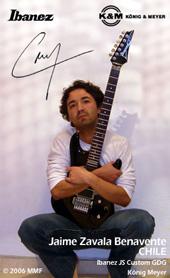
Jaime Zavala's Virtuosity

Nacido en 1976 en Viña del Mar, Jaime Zavala Benavente comenzó en 1988 sus estudios de guitarra y teoría. Aunque siempre se negó a tomar clases, sus propios métodos, altamente rigurosos y disciplinados, lo llevaron a transformarse en uno de los guitarristas más dotados técnica e interpretativamente, lo que habla de su gran capacidad musical y creativa.
Durante sus primeros años, Jaime Zavala se dedicó a absorber todo lo que llegaba a sus oídos: el rito diario lo constituían las 8 horas de estudio que cumplía religiosamente, donde analizaba la técnica de los guitarristas de bandas que sonaban en las radios en aquellos años, y estudiaba también Guitarra Clásica y Teoría Musical.
El esfuerzo de Zavala rápidamente daría que hablar. Ya en 1991, Jaime Zavala era permanentemente invitado a eventos en distintos colegios de Viña del Mar, donde deslumbraba a la audiencia por su virtuosismo y juventud. Pero Zavala, siempre en una posición extremadamente autocrítica, solía reprobar sus interpretaciones. Esto se debía a que recién durante ese tiempo tuvo la oportunidad de escuchar a algunos de los mejores guitarristas del mundo. Yngwie Malmsteen, Vinnie Moore y Joe Satriani se transformaron en la obsesión desde ese entonces para Zavala. Por ello estuvo ausente de todo evento hasta fines de 1992; sólo en ese entonces consideró que estaba en condiciones de presentarse. Pero la obra de los grandes maestros clásicos desde el comienzo acompañó a Zavala. Johann Sebastian Bach y Nicolò Paganini, sus preferidos, siempre tuvieron el más alto sitial en el concepto musical de Zavala. El problema era que no había forma de unir escuelas tan distintas, por ello Zavala se mantenía estudiando Guitarra Clásica, Guitarra Eléctrica y Teoría Musical en forma separada.
Definitivamente inclinado a estudiar Guitarra Eléctrica, pero sin intenciones de olvidar sus estudios paralelos, Zavala logró depurar su técnica hasta lograr un nivel jamás imaginado. En 1994, con sólo 18 años, se había transformado en uno de los mejores guitarristas de la región.
Al ingresar a la carrera de Ingeniería Civil Electrónica, en la Universidad Católica de Valparaíso, Zavala debió ceder la mayor parte de su tiempo, antes dedicado a la música, al estudio científico. Pero eso no significó un obstáculo en la carrera musical Jaime Zavala, puesto que al verse limitado en el estudio y ejecución de la Guitarra Eléctrica, se dedicó a perfeccionar sus conocimientos de Teoría Musical, con el apoyo del músico Javier Pozo. En ese momento comienza a concretarse uno de los sueños más profundos de Jaime Zavala: componer música, bajo una sólida base teórica y una fuerte inspiración emocional. En 1994 se integra al staff de trabajo de Yngwie Malmsteen, lo que facilita de gran manera su difusión internacional. Durante el verano de 1995 Zavala se presentó con gran éxito en distintos eventos en Santiago. Su reputación de virtuoso, que siempre le ha molestado, comenzaba a conocerse. Pero en ese año Zavala estuvo muy complicado con su problema vocacional: Tenía mucho que entregar pero sus estudios de Ingeniería no lo dejaban rendir el cien por ciento. Y Zavala no estaba dispuesto a rendir menos que eso. Fue durante 1995 en que Jaime Zavala se dio cuenta que "hacer música es mucho más que interpretarla". En ese momento decidió dar prioridad al estudio y a la composición que al escenario.
En 1996 Zavala ya era reconocido como uno de los grandes guitarristas de Chile. En Mayo, el GIT del Musician's Institute of California, en Estados Unidos, publica durante un mes sus lecciones "Advanced Techniques for Electric Guitar". En ese año comienza a concebir la idea de transcribir obras doctas para ser interpretadas por instrumentos modernos, en su afán de lograr la perfecta comunión de sus dos tendencias musicales, y compone varias de las Sonatas que componen su Op.1. También se presenta con éxito en conciertos en Viña del Mar y Santiago.
1997 es uno los años más fructíferos para Zavala. Compone la gigantesca obra "Magno Himno CDP Op.2", para orquesta sinfónica y banda; termina de escribir las "7 Sonatas para Guitarra Clásica Op.1", comienza con sus primeras transcripciones de obras doctas, que finalmente conformarán el Op.4, y escribe un grupo de 4 estudios para Guitarra Eléctrica publicados como "The Electric Guitar Etudes Op.3", piezas que persiguen el afán instructivo de los 24 Capricci de Nicolò Paganini.
En 1998, crea el Tour de Force, nombre con el que bautizó sus conciertos de música docta para Guitarra Eléctrica (y el nombre que se daba en el siglo XVIII a los conciertos para violín de compleja ejecución). Decide dar prioridad al estudio y la composición, y realiza sólo 4 conciertos durante este año. Hace una magistral transcripción del Himno Nacional de Chile, para Guitarra Clásica, y del Himno Inglés "God Save The Queen", que forman "Transcriptions of National Anthems Op.5" y crea su primera obra para orquesta de cámara, "Concerto Nº1 in Sol maggiore Op.6". Trabaja inspirado en las composiciones de Jaime Barría, fundador de la banda chilena Bordemar, en un proyecto de folklore moderno, de donde aparecerá la "Cueca Progresiva". En Noviembre es aceptado como miembro del grupo mundial de Discusión y Análisis de la obra de Johann Sebastian Bach.
Durante 1999, compone un par de sonatas para Guitarra Clásica bautizadas como "Madre e Hija Op.7"; el "Concerto Nº2 in Mi minore Op.8", la "Overture Lorena Op.10" y "Allegro for Gabriela Op.11" (Obras para orquesta de cámara); el "Presto Op.9" (Obra para Clavecín), y varios experimentos musicales no catalogados. Realiza un par de conciertos en Santiago, fuera del concepto de Tour de Force.
El año 2000 momentos importantes suceden en la carrera de Jaime Zavala. Viaja a Estados Unidos, a buscar la magnífica guitarra que encargó a Ibanez, bautizada como "Ibanez Guarneri del Gesú", un verdadero lujo de instrumento que contribuye a realzar la técnica y calidad interpretativa de Jaime Zavala. En Mayo, el Istituto di Studi Paganiniani de Génova declara aprobada su transcripción para Guitarra Eléctrica de una de las sonatas para violín de Nicolò Paganini. Algunos críticos afirman que "hay muchos virtuosos pero Zavala es el único que logra hacer hablar su guitarra", por lo que la demanda por ver en vivo a Zavala, interpretando sus complejas transcripciones en su excepcional guitarra, se torna aún más alta cuando anuncia que el 2000 será el último año del Tour de Force. Finalmente, en los últimos días de Diciembre, en un pequeño lugar y acompañado por sus familiares y amistades más cercanas, realiza el Grand Finale del Tour de Force.
En Febrero del año 2001, Jaime Zavala se incorpora como guitarrista estable al proyecto musical de MOMO. En una nueva faceta, totalmente ajena al virtuosismo que le valió el respeto de mucha gente y en muchos lugares del mundo, Zavala espera seguir con su objetivo: "más allá de la música, de la técnica y de lo que representa en sí la interpretación, están los sentimientos y los lugares mágicos a los cuales te puede llevar una melodía. Si yo, con mi música, soy capaz de llevar a alguien a esos lugares y de lograr que afloren los sentimientos, ese es el mejor premio que puedo recibir".

Antonio Jara, Kammermusic das Köln Orchester, Mayo 2001.
Contact: jzavalab@hotmail.com

Lisa Krueger's Cut

Lisa Krueger directs Heather Graham on the set of Miramax's Committed - 2000

LISA KRUEGER (writer/director) grew up in the suburbs of San Francisco and attended the University of California at Berkeley. In her Junior year she was one of three undergraduates to be invited to the university's graduate-level Paris Film Program. After her year in Paris, Krueger returned to Berkeley, where she wrote an honors thesis on film music. After graduation, she returned to Paris, where she continued her studies under the direction of Christian Metz at the Ecole des Hautes Etudes en Sciences Sociales, and taught English at the University of Paris and at the American Center for Students and Artists. She began experimenting with the American Center's extensive video equipment, and was commissioned by the Center to create a series of video vignettes for use in its classrooms. Moving to New York City, Krueger worked briefly as an assistant to the video curator of the Museum of Modern Art, and then became a production manager for Academy Award-winning director Zbigniew Rybczynski. She also line-produced the American segments for Alain Tanner's "La Vallée Fantôme" and Pierre Granier Deferre's "La Couleur de Vent." Eager to move from production to directing, Krueger took up script supervision, or continuity, as a kind of "earn while your learn" film school. As a script supervisor, she worked closely with such directors as Jim Jarmusch (on "Mystery Train" and "Night on Earth"), Abel Ferrara ("King of New York") and James Ivory ("Mr. and Mrs. Bridge"), and was able to absorb first-hand the creative and technical aspects of movie-making. She then wrote, directed and co-edited "Best Offer," a half hour short described as a "coming of age story about a young girl's transition from four-legged love objects (horses) to two-legged ones (boys)." Featuring cinematography by her brother Tom and production design by her brother Mathew, "Best Offer" premiered at the 1993 Sundance Film Festival and went on to win awards at the San Francisco Film Festival, Chicago Film Festival, Houston Worldfest, Oberhausen and the CINE Golden Eagle, among others. "Best Offer" was also licensed for numerous television showings around the world. Krueger's first feature-length screenplay, "Manny & Lo," was honored by Robert Redford's Sundance Institute when it was chosen for its 1994 June Filmmakers and Writers Lab. As a "Sundance Fellow," Lisa was invited to rehearse, shoot on video and edit scenes from "Manny & Lo" with the actors of her choice (among them Mary Kay Place) over the course of four weeks in the mountains of Utah. Seasoned filmmakers/advisors were on hand to offer feedback, including Robert Redford, Arthur Penn, Alan Pakula, Paul Brickman, Richard Pierce, Morgan Freeman, Sally Field, and others. The institute also organized a stage reading of "Manny & Lo" with Morgan Freeman narrating. (Other films developed at the Sundance Filmmakers Lab include "Reservoir Dogs," "Impromptu," "Fresh," and "I Like It Like That.") Lisa Krueger currently divides her time among Los Angeles, San Francisco and New York.

Friday, May 25, 2007

9 Pirate Lords of The Brotherhood

The film begins with Lord Cutler Beckett unmercifully executing mass amounts of people who are associated with piracy. Among them is an innocent looking young boy who starts singing a pirate song, Hoist the Colours. This song continues to be sung by the group who is waiting to be executed and it leads on to Elizabeth Swann, who is rowing a small sampan in Singapore. She arrives on shore with Captain Barbossa and they enter the bath house of Chinese pirate Sao Feng. Outside, Tia Dalma is disguised as a common hawker, and the rest of the crew break into the bath house for backup in case a fight breaks out. Inside, Captain Barbossa and Elizabeth reveal that they are here to ask for a ship and crew so they can rescue Jack Sparrow, who is trapped in Davy Jones' Locker. Sao Feng laughs as this request, claiming to be mortal enemies with Jack Sparrow, and revealing the coincidence that a thief had come to steal his navigational charts earlier that day. Will Turner, the thief, is pulled out of a tub of water and both Elizabeth and Barbossa look surprised, as they never expected Will to get caught. Sao Feng asks if the thief is part of theirs, and both of them deny it. But Elizabeth cries out just as Sao is about to stab Will. Sao Feng stops and spots a man with a fake dragon tattoo. Assuming that he is part of Barbossa's crew, Sao Feng's men pull out their swords, ready to fight and Barbossa and Elizabeth. Will points out the fake tattoo man isn't part of either party and suddenly, soldiers of the East India Trading Company burst in through the door firing their guns. A fight between the pirates and the Company ensue. Sao Feng and Will fight but negotiate a deal and Sao Feng offers them a junk and crew. Mr. Mercer, Beckett's right hand man in hiding overhears this but does not kill either of them.

Barbossa, Elizabeth, Will and the crew journey through a frozen ocean, with the help of Sao Feng's maps which Will stole after the fight. Tia Dalma explains that she couldn't revive Captain Jack Sparrow the same way as Barbossa as Barbossa was only killed, and his soul was taken to the land of the dead. As for Jack, he was taken both body and soul to Davy Jones' Locker. They continue sailing until Will spots at the horizon an enormous waterfall, which is the world's edge where all the sea ater pours over, and orders the crew to turn the ship around. However, Barbossa dismisses that order and shouts for the crew to let the ship be. They fall down the waterfall and into Davy Jones' Locker.
While imprisoned there,
Jack Sparrow is confronted with the many facets of his character before jumping off his marooned Black Pearl. All around the ship is plain desert and with the help of some crabs, the Black Pearl is able to be dragged towards a beach. At that moment, the crew from the junk arrive and see the ship and Jack himself. They greet him warm heartedly, but Jack retorts that why should he sail with them, since four of them had tried to kill him, and one of them succeeded. Will turns around to see Elizabeth looking guilty as ever.
Despite their mutual animosity and distrust, Sparrow and Barbossa form an alliance when they discover
Cutler Beckett possesses the heart of Davy Jones, has begun purging piracy with the commanded assistance of Davy Jones and the Flying Dutchman ship. The world's pirates must gather for a meeting of the brotherhood known as the Brethren of the Coast, consisting of nine pirate lords, and they should hurry, because the pirate song has already been sung.
During a squabble between Sparrow and Barbossa on board the Black Pearl, Sao Feng and his men appear claiming the ship and names Will as captain. Everyone is taken by surprise, especially Elizabeth. Barbossa tries to negotiate a deal, claiming he has Calypso, goddess of the sea, in her human form. Sao Feng looks at Elizabeth and captures her to his ship, the
Empress. That evening Sao Feng pampers the captured Elizabeth and calls her Calypso. The Empress is suddenly attacked by the Flying Dutchman and Sao Feng is killed. Elizabeth is chosen by him to be the new captain of the Empress, due to his belief that she is Calypso, despite the revelation that Tia Dalma is. The Empress crew and Elizabeth is then held prisoner in the Flying Dutchman, controlled by Lord Beckett.
On board the Flying Dutchman, Elizabeth meets Will's father,
Bootstrap Bill who appears to have amnesia. James Norrington, the East India Trading Company commander of the Flying Dutchman frees the Empress crew and Elizabeth. Bootstrap Bill realizes this, alarms others and then kills James Norrington.
At the Brethren of the Coast, eight of the nine pirate lords discuss the threat of Beckett and the release of Calypso from her imprisoned human form. Expecting Sao Feng to show up and reach a decision, they see Elizabeth instead. Every pirate argues over the matters at hand and Jack proposes they make a king. Since every pirate lord only has one vote, and that they would only vote for themselves, everyone is taken by awe when Jack votes for Elizabeth instead of himself, making her the Pirate King of the Brethren. Against Barbossa's persuasion, Elizabeth orders the pirates to fight against Beckett and leave Calypso be.

As all the pirates get ready to fight they see the horizon filled with Lord Beckett's massive fleet and are dumbstruck. Barbossa then frees Tia Dalma/Calypso and ask her to help in the battle between pirates, Davy Jones, the Royal Navy, and the
East India Trading Company. In this climactic battle in a maelstrom, Elizabeth and Will are joined in matrimony by Captain Barbossa whilst fighting the crew of the Flying Dutchman. Soon after Davy Jones stabs Will in the heart, but Jack takes Davy Jones' heart and Will stabs it, killing Davy Jones.
He who kills the captain of the Flying Dutchman must replace the captain for eternity. Therefore Will is now the captain of the Flying Dutchman. Elizabeth is heartbroken, thinking Will is dead, but as the Flying Dutchman emerges from within the sea, Will is alive and the crew has returned to normal. The pirates of the Black Pearl and the Flying Dutchman then turn to face Cutler Beckett, and sink him and his ship to the depths.
The pirates emerge victorious, but learn that the Flying Dutchman must stay in the undersea-world and can only come to shore for one day, every ten years. Will and Elizabeth spend their "last day" together on a beach and she promises she will wait for him and keep his heart safe. Jack embarks on a quest to find the fountain of youth. After the credits, it is revealed that Will and Elizabeth have had a son, whose name is also William Turner, and the family is seen reuniting ten years later. Whether Will will have to stay on the Flying Dutchman, or whether Elizabeth's fidelity will allow them to be together, is unclear at the finale.

Wednesday, April 04, 2007

300: Atlanteans versus Lemurians


300 is a 2007 film adaptation of the graphic novel 300 by Frank Miller, itself partly inspired by another film, The 300 Spartans,[1] and is a fictional[2] account of the Battle of Thermopylae in 480 BC. The film is directed by Zack Snyder with Frank Miller attached as an executive producer and consultant, and was shot mostly with bluescreen to duplicate the imagery of the original comic book.
Spartan King Leonidas (Gerard Butler) and 300 Spartans fight to the last man against Persian King Xerxes (Rodrigo Santoro) and his army of over one million soldiers, while in Sparta, Queen Gorgo (Lena Headey) attempts to rally support for her husband. The story is framed by a voice-over narrative by the Spartan soldier Dilios (David Wenham). Through this narrative technique, all manner of fantastical creatures are introduced, placing 300 within the genre of historical fantasy.
300 was released in both conventional and
IMAX theaters in America on March 9, 2007. The film broke box office records, although critics were divided over its look and style. Some acclaimed it as an original achievement, while others accused it of favoring visuals over characterization. Controversy arose over its depiction of the ancient world. A group of Persian messengers arrive at Sparta, demanding Sparta's submission to King Xerxes. Outraged and offended at their behavior, King Leonidas and his guards throw the messengers into a pit, resolving to face the Persians. Leonidas then visits the Oracle, explaining his plan of war with the Persians and offers a customary payment in gold. The priests of the Oracle, having already been bribed by Xerxes, interpret her message to mean that Sparta should not go to war, so as to not interrupt the sacred Carneian festival.
Despite the warning, Leonidas gathers 300 of his best soldiers to fight the Persians, selecting only those who have already sired male children. As they march North, they are joined by a group of Arcadians and other Greeks. Arriving at the narrow cliffs of Thermopylae (referred to as the "Hot Gates"), in sight of the Persian army, they build a wall to halt the Persians' advance. Ephialtes, a hunchbacked Spartan whose parents had fled to save him from customary infanticide, approaches Leonidas, requesting to redeem his father's name in battle, and warning him about a secret goat path that the Persians could use to surround them. Leonidas turns him away as his inability to properly hold the shield would create a weak spot in the phalanx.
Before the battle starts, the Persians ask that the 300 drop their arms. Leonidas responds; "Persians!
Come and take them!" The Spartans use the phalanx formation and hand to hand combat to fight off numerous waves of attackers including Xerxes's elite guard, the Immortals. The 300 defend their position while suffering relatively few losses. Xerxes, impressed, personally approaches Leonidas and promises him wealth and power in exchange for his surrender. The Spartan king declines, saying that he will instead make the "God King" bleed. Shortly thereafter, an embittered Ephialtes reveals the location of the goat path to Xerxes, having been promised a lucrative and powerful position in the Persian Empire.
Back in Sparta, Queen Gorgo, upon the advice of a councilman, attempts to enlist the influential Theron to help her persuade the Spartan council to send reinforcements to Leonidas. Theron agrees to help, but demands that Gorgo submit sexually to him; Gorgo reluctantly assents. Meanwhile, the Greeks realize that Ephialtes has betrayed them, and the Arcadians decide to retreat in the face of certain death. The Spartans refuse to follow, obedient to their law. Leonidas orders only one man, Dilios, to retreat and use his rhetorical skills to tell the story of the 300 to the Spartan people, ensuring that they be remembered. Dilios reluctantly leaves with the Arcadians. At Sparta, Queen Gorgo appears in front of the council, but is not supported by Theron, who furthermore accuses her of adultery. The Queen, enraged at this betrayal, snatches a sword from a nearby soldier and kills Theron. Persian coins fall from his purse, the Council denounces him as a traitor, and unites against Persia.
At Thermopylae, the Persians have surrounded the 300 on all sides. Xerxes's spokesman demands their surrender, saying that Leonidas may keep his title as King of Sparta and become warlord of all Greece, answerable only to Xerxes. In defiance, Leonidas throws his spear at Xerxes, cutting his cheek, delivering on his promise to "make the 'God King' bleed." Shaken at the reminder of his own mortality, Xerxes orders his archers to fire. The remaining Spartans are killed in the hail of arrows, with Leonidas dying last. Dilios eventually returns to Sparta and inspires the council with the bravery of the 300.
Dilios finishes his tale of the 300 on a new battlefield surrounded by raptly listening soldiers. He concludes that the Persian army, who defeated a mere 300 Spartans a year earlier with great difficulty, must now be terrified to face 10,000 Spartans and 30,000 Greeks from the other city-states. The roused Greek host heads off to fight the Persian army, beginning the
Battle of Plataea.

Edward Abramovitz, The Alquimist

"Mesmerizing; the Illusionist casts an exquisitely bewitching spell with its dreamy atmosphere and persuasive sense of suspense. Neil Burger has fashioned a beautifully shot mystery, with precise and elegant attention to period detail, which heightens the sense of intrigue in this romantic thriller. The well crafted tale is bolstered by the powerful performance of Edward Norton. Just as strong are Paul Giamatti and Rufus Sewell. This suspenseful and stylish film has a welcome sense of originality. The story is rendered fluidly, with gorgeous production design, and the haunting score by Philip Glass adds to the spellbinding quality. It is a pleasure to see Edward Norton deliver yet another remarkable performance."


Claudia Puig - USA TODAY


The film begins in medias res (in the middle of the story) as chief inspector Uhl (Giamatti) recounts the history of Eisenheim for Crown Prince Leopold, following Eisenheim's arrest during what appears to be necromancy passed off as a magic show. As a teenager, young Eisenheim (played by Aaron Johnson) is the son of a cabinetmaker. One day, he meets a traveling magician along a road. The magician performs several tricks for him and then, according to various accounts, both the magician and the tree he was sitting under vanish. Eisenheim becomes obsessed with magic tricks after this and also falls in love with Sophie von Teschen (Biel), a duchess well above his social standing, and the daughter of the parents that have hired Eisenheim's father as a cabinetmaker. Although the two are forbidden to see each other, they meet in a secret hideout in the woods, where Eisenheim tells of his plans to go to China to learn more magic and Sophie promises to go with him. On the day that they are going to leave, however, the police come looking for Sophie. The two hide in the secret room and Sophie begs Eisenheim to make them both disappear. He is unable to fulfill this request, however, and the two are separated. Eisenheim leaves his village to travel the world and perfect his magic after this. He returns a master illusionist. He meets Sophie at his performance when she volunteers as a participant in his trick. He soon learns that Sophie is expected to marry the ruthless Crown Prince Leopold (Sewell), who is well known for abusing his lady friends. After humiliating the crown prince during a private show, Eisenheim finds his hit performance shut out of Vienna. Eisenheim and Sophie, having recognized each other from his previous performance, meet privately and finally consummate their love. Their romance begun anew, they plan to elope; but first, Sophie points out, something must be done to stop Leopold, who, she reveals, is planning a coup d'etat to take control of Austria from his aging father, Emperor Franz Joseph, while using his engagement to her to win the support of Hungary. When Leopold finds out from Uhl, who was following the couple, he apparently kills Sophie in a drunken rage. Unfortunately, Leopold's aristocratic social standing makes any accusations against him unthinkable. As Eisenheim plunges into despair and the citizens of Vienna begin to suspect Leopold of murder, Uhl begins to observe Eisenheim's actions more closely.
Racked with grief, Eisenheim prepares a new kind of magic show, using mysterious equipment and
Chinese stagehands. Eisenheim purchases a run-down theater and opens a new performance. During his show, Eisenheim apparently summons spirits, leading many to believe that he possesses supernatural powers. Uhl attempts to stop his show but is unsuccessful.
Leopold decides to attend one of Eisenheim's shows in disguise. During this show, Eisenheim summons the spirit of Sophie, who says someone in the theater murdered her, panicking Leopold. Uhl pleads with Eisenheim to stop, but Eisenheim refuses; he is bent on being with Sophie and ruining the crown prince and the ruling Habsburg house. Finally, Leopold orders Eisenheim's arrest, but when Uhl tries to arrest him during a live show, Eisenheim's body fades and disappears, implying that he did not perform the show as a corporeal human being that night but, rather, as a "spirit".
At this point, we return to the first scene of the movie. Uhl reveals to Leopold that he has found evidence which points to the crown prince as Sophie's murderer: a jewel from the prince's sword, and Sophie's locket that Eisenheim gave her when they were kids. After ordering, then begging Uhl to keep silent, Leopold discovers that Uhl has already informed the emperor's general staff not only of his findings but of Leopold's plans to usurp the Austrian throne. When the general staff arrives at his palace, Leopold shoots himself in despair after sadly reflecting on the state of Austria's corrupt government.


In the next scene, Uhl is shown leaving the imperial castle. After he takes a few steps, a boy runs up to hand him a folio labeled "Orange Tree" – the name of one of Eisenheim's illusions which had intrigued Uhl – and unlike before, it is filled with plans detailing a geared mechanism to make the tree "grow". Uhl demands to know where the child found the folio and is told that Eisenheim had given it to him. Uhl spots Eisenheim wearing a disguise and follows him to the train station. During his chase, Uhl begins to make mental connections, shown in the form of flashbacks. He realizes that Sophie's murder was in fact itself an illusion created by Eisenheim in order to escape with his love and bring down Leopold. After the flashbacks, Eisenheim is seen making his way to the country, where Sophie awaits him.


Monday, April 02, 2007

Family As A House


Life as a House is a 2001 film starring Kevin Kline, Kristin Scott Thomas, and Hayden Christensen. Directed by Irwin Winkler and written by Mark Andrus, the film involves the metaphorical and emotional underpinnings of demolishing and reconstructing a house. The film is set in picturesque Rancho Palos Verdes, California and is notable for its dramatic use of the coast and of sunsets.Kevin Kline plays George Monroe, who is fired from his job as a designer of architectural models and is diagnosed with terminal cancer. He enlists the help of his reluctant and rebellious son Sam, played by Hayden Christensen, to demolish the shack that George inherited from his abusive father and build an elegant home in its place. During this experience, George reconnects with his son and his divorced wife Robin, played by Kristin Scott Thomas. The movie is a source of discovery both for George and Sam. Sam in particular changes from a rebellious drug taking teen into something more closely resembling his father. This is evident in the final sequence, in which Sam gives the house to a woman disabled by a car accident caused by George's father while driving under the influence.

"Life as a house seen from a distance, it's perfect."

Saturday, March 31, 2007

Unbreakable


Friday, March 30, 2007

Wednesday, March 28, 2007

El Manto Sagrado


Wednesday, March 21, 2007

The Secret

In some place, Afrika keep hiding away the ark

Wednesday, March 07, 2007

The Body

The Body is a 2001 film based on a novel by Richard Sapir, and starring Antonio Banderas and Olivia Williams.
The movie follows Father Matt Gutierrez (Banderas), a
Jesuit priest sent by the Vatican to investigate an archaeologic finding by Dr. Sharon Golban (Williams) which is suspected to be the remains of the body of Jesus Christ. This finding puts Gutierrez' faith and his doubts in constant confrontation with Golban's scientific views. Also, the finding stirres the political problems between Palestine and Israel in the area, while also shaking the foundations of Christianity itself. Both of these problems put Dr. Golban, and Gutierrez himself, in danger. Dr. Sharon Golban (Williams) finds an ancient skeleton in Jerusalem in a rich man's tomb. Coloration of the wrist and leg bones indicates the cause of death was crucifixion. other signs, include a gold coin bearing the marks of Pontius Pilate and faint markings around the skull, lead authorities to suspect that these could be the bones of Christ. The different reactions of politicians, clerics, religious extremists—some prepared to use terror to gain their ends—to the religious, cultural and political implications of the find, make life difficult and dangerous for the investigators as they seek to unearth the truth.
Father Matt Gutierrez, is assigned by the Vatican to investigate the case and to protect the Christian faith. Troubled by his case, he comes to understand that it is the Church that he is protecting and not the faith.

Monday, March 05, 2007

Friday, February 02, 2007

Write on Another Side of Paper

Mel Columcille Gerard Gibson AO (born January 3, 1956) is an Australian raised American born actor, director, and producer. After establishing himself as a household name with the Mad Max and Lethal Weapon series, Gibson went on to direct and star in the Academy Award-winning Braveheart. Gibson's direction of Braveheart made him only the sixth actor-turned-filmmaker to receive an Oscar for Best Director.[1] In 2004, he directed and produced The Passion of the Christ, a blockbuster movie that portrayed the last hours of the life of Jesus.

Early life
Mel Gibson is the son of Hutton Gibson and Anne Reilly Gibson. His paternal grandmother was the Australian opera singer, Eva Mylott. He was born in Peekskill, New York, the sixth of eleven children. One of Mel's younger brothers, Donal, is also an actor. Gibson's first name comes from a 5th century Irish saint, Mel, founder of the diocese of Ardagh containing most of his mother's native county, while his second name, Columcille is also linked to an Irish saint.[2] Columcille is the name of the parish in County Longford where Anne Reilly was born and raised. Although Gibson is a native-born United States citizen, Gibson's father relocated the family to Australia in 1968, after his father won a work related injury lawsuit against New York Central after a seven day trial on February 14, 1968 where the jury awarded him $145,000.[3] The family moved when Gibson was twelve. This move was in protest of the Vietnam War for which Gibson's elder brothers risked being drafted. It is also because Gibson's father believed that changes in American society were immoral.

Film career
Gibson graduated from the National Institute of Dramatic Art in Sydney in 1977. His acting career began in Australia with appearances in television series, including The Sullivans, Cop Shop and Punishment. Gibson's handsome boyish good looks made him a natural for leading male roles in action projects such as the "Mad Max" series of films, Peter Weir's Gallipoli, and the "Lethal Weapon" series of films. Later, Gibson expanded into a variety of acting projects including human dramas such as Hamlet, and comedic roles such as those in Maverick and What Women Want. His greatest artistic and financial success came with films where he expanded beyond acting into directing and producing, such as 1993's The Man Without a Face, 1995's Braveheart and 2004's Passion of the Christ.

Mad Max

Gibson made his film debut as the leather-clad post-apocalyptic survivor in George Miller's Mad Max. The film was totally independently financed and had a reported budget of $300,000 AUD — of which $15,000 was paid to Mel Gibson for his performance. The film achieved incredible success, and went on to earn $100 million world wide. It held a record in Guinness Book of Records as the highest profit-to-cost ratio of a motion picture, and only lost the record in 2000 to The Blair Witch Project. The film was awarded four Australian Film Institute Awards in 1979. When the film was first released in America, all the voices, including that of Mel Gibson's character, were dubbed with U.S. accents at the behest of the distributor, American International Pictures, for fear that audiences would not take warmly to actors speaking entirely with Australian accents. The original film spawned two larger sequels: Mad Max 2 (known in North America as The Road Warrior), and Mad Max 3 (known in North America as Mad Max Beyond Thunderdome). A fourth movie, Mad Max 4: Fury Road, has been considered but has not been produced.

The Bounty

In 1984, starred as Fletcher Christian in The Bounty. Reportedly, Gibson and Anthony Hopkins, his costar on the film, did not get along during the shoot. At the time, Anthony Hopkins was a teetotaler, and Mel Gibson was struggling with alcoholism. Gibson frequently spent his evenings in local saloons and took to mixing two shots of Scotch with his beer. He dubbed the concoction "Liquid Violence". In one incident, Gibson's face was severely cut up in a bar room brawl and the film's shooting schedule had to be rearranged while he was flown to a hospital in Papeete.

Lethal Weapon

Gibson moved into more mainstream commercial filmmaking with the popular Lethal Weapon series, in which he starred as LAPD Detective Martin Riggs, an emotionally unstable Vietnam veteran with a death wish and a penchant for violence and gunplay. In the films, he was partnered with the elder and more reserved Roger Murtaugh (played by Danny Glover). This series would come to exemplify the action genre's so-called buddy film. The two actors were trained in two different schools of acting. Gibson is classically trained and Glover is a method actor. Three sequels were produced.

Hamlet

Gibson made the unusual transition from the action to classical genres, playing the melancholy Danish prince in
Franco Zeffirelli's Hamlet. Gibson was cast alongside such experienced Shakespearean actors as Ian Holm, Alan Bates, and Paul Scofield. He described working with his fellow cast members as similar to being "thrown into the ring with Mike Tyson". The film met with critical and marketing success and remains steady in DVD sales. It also marked the transformation of Mel Gibson from action hero to serious actor and filmmaker.

Braveheart

Gibson stated that when the Braveheart script arrived and was recommended by his agents, he rejected it outright because he thought he was too old to play the part. After careful thought, he decided to not only act in the film, but to direct it as well. Gibson received two Academy Awards, Best Director and Best Picture, for his 1995 direction of Braveheart. In the movie, Gibson starred as Sir William Wallace, a thirteenth-century Scottish freedom fighter. He said in interviews that he was attempting to make a film similar to the epics he had loved as a child, such as Stanley Kubrick's Spartacus and The Big Country. The filming began in the Scottish Highlands. After learning that the intended filming locations were among the rainiest spots in Europe, the shooting was moved to Ireland, where members of the Irish Army Reserve worked as extras in the battle scenes.

The Passion of the Christ

Gibson co-wrote, produced and directed the The Passion of the Christ. The 2004 film was based on the last twelve hours of the life of Jesus according to the most widely recognized Christian gospels, rendered multilingually in Aramaic, Hebrew, and Latin. Reviews were mixed, with critics ranging from praising the film for its realistic depiction of Jesus' final hours from a Catholic point of view and criticism of violence, manipulation and charges of anti-Semitism.[4][5] Asked if his movie would "upset Jews", Gibson responded, "It's not meant to. I think it's meant to just tell the truth. I want to be as truthful as possible."[6] Accusations of anti-Semitism were fueled by revelations that Mel Gibson's father Hutton Gibson is a vocal Holocaust denier who believes much of the Holocaust is "fiction".[7] On his decision to cut the scene in which Caiaphas says "his blood be on us and on our children" soon after Pontius Pilate washes his hands of Jesus, Gibson said:
I wanted it in. My brother said I was wimping out if I didn't include it. But, man, if I included that in there, they'd be coming after me at my house. They'd come to kill me.>
[8][9][10] The movie grossed US$ 611,899,420 worldwide and $370,782,930 in the US alone. It became the eighth highest-grossing film in history and the highest-grossing rated R film of all time. The ticket sales were boosted by the film attracting viewers who generally do not attend theaters, including entire church congregations.[11] The film was nominated for an Academy Award for Original Music Score, Best Cinematography, and Best Makeup at the 77th Academy Awards and won the People's Choice Award for Best Drama. The movie was the subject of the feature documentary 'Impact: The Passion of the Christ' (http://www.Impactthemovie.com) by writer/director Tim Chey (http://www.TimChey.net) which was released into the theaters and is now on DVD.

Apocalypto

Gibson's next historical epic, Apocalypto, was released to theaters on December 8, 2006. The film is set in Mesoamerica, during the period immediately before the Spanish conquest. It focuses on the decline of the Maya civilization which reached its zenith around 600 AD. Dialogue is spoken in the Yucatec Maya language. It features a cast of unknown actors from Mexico City, the Yucatán, and some Native Americans from the United States. While Gibson financed the film himself, Disney released it in specific markets. The film is set against the turbulent end times of the once great Maya civilization. When a Maya man's idyllic existence is brutally disrupted by a violent invading force, he is taken on a perilous journey. Through a twist of fate and spurred by the power of his love for his woman and his family he will make a desperate break to return home and to ultimately save his way of life. The title is a Greek term which means "an unveiling" or "new beginning", but the movie is not religiously themed or connected to the biblical Apocalypse. Gibson pre-screened Apocalypto to two predominantly Native American audiences in Oklahoma, at the Riverwind Casino in Goldsby, owned by the Chickasaw Nation, and at Cameron University in Lawton [1].

Family

On June 7, 1980, Gibson married Robyn Moore, a nurse whom he met through a dating service, in a Catholic Church in Forestville, New South Wales. He has referred to his wife as "my Rock of Gibraltar, only much prettier." They have seven children, one daughter and six sons: Hannah (born 1980), twins Edward and Christian (born 1982), Willie (born 1985), Louis (born 1988), Milo (born 1990), and Tommy (born 1999). Gibson is Roman Catholic and his wife is Anglican. He holds to the Catholic doctrine of "Extra Ecclesiam Nulla Salus", and when asked how this doctrine would affect his wife, he said: "There is no salvation for those outside the Church; I believe it. My wife is a saint. She's a much better person than I am. Honestly. ... She prays, she believes in God, she knows Jesus, she believes in that stuff. And it's just not fair if she doesn't make it; she's better than I am. But that is a pronouncement from the chair. I go with it.” [12] Hannah Gibson, Mel's eldest child and only daughter, married the musician Kenny Wayne Shepherd on September 16th, 2006. [13] She had previously considered becoming a Catholic nun or religious sister. [citation needed] On December 17, 2006, British tabloid newspaper News of the World published claims by a 29 year-old Australian woman, Carmel Sloane, that Gibson is her father. The story reports that she intends to serve legal papers demanding a DNA paternity test if he refuses to admit to this relationship. [14]

Personal and Political Views
Religion

Based on many of his positions, Gibson can be considered a traditionalist Roman Catholic. In 2004, he publicly condemned taxpayer-funded embryonic stem-cell research that involves the cloning and destruction of human embryos. In March 2005, he issued a statement condemning the ending of Terri Schiavo's life, referring to her death as "state-sanctioned murder" on Sean Hannity's radio show.[15] He is a proponent of the death penalty, which the traditional doctrine of the Roman Catholic Church allows for under specific circumstances, but which post-Vatican II Popes have said is rarely justifiable in modern society.[16] Gibson has expressed the belief that God is pointing out his path, particularly with respect to the making of The Passion of the Christ. In 2003 he told The New Yorker "There are signals. Signal graces, they are called. It's as clear as a traffic light. Bing! I mean, it just grabs you and you know you have to listen to that and you have to follow it."[17] At a screening of the film for clergy, he stated that the Holy Spirit was making the film through him, "I was just directing traffic".[17]

Politics

While having never identified himself as being a conservative Republican, Gibson has been referred to as one in The Washington Times, and WorldNetDaily once reported that there was grassroots support among Republicans for "a presidential run".[18]. Gibson praised liberal director Michael Moore and his documentary film Fahrenheit 9/11.[19] Gibson's Icon Productions originally agreed to back Moore's film, but abruptly sold the rights to Miramax Films. Moore has claimed that "top Republicans" intimidated Mel Gibson into relinquishing the film.[20] In a July 1995 interview with Playboy magazine, Gibson said President Bill Clinton was a "low-level opportunist" because someone was "telling him what to do". He said he thought Clinton and other politicians who had won Rhodes Scholarships were part of a "stealth" trend of Rhodes scholars becoming politicians who were striving for a "new world order." He said this was a form of Marxism.[21][22] In 2006 Gibson told the UK film magazine EMPIRE that the "fearmongering" depicted in his film Apocalypto "reminds me a little of President Bush and his guys."[23] He has criticized the Iraq War in interviews. [2]

His critics

Gibson has expressed strong opinions of his critics. In an interview with Playboy, he said of the author of an unauthorized biography, "I don't think God will put him in my path. He deserves death."[21] After Frank Rich of the New York Times wrote that Gibson's Passion of the Christ would inflame anti-Semitism and accused Gibson of "protecting a Holocaust denier" by refusing to denounce his father, Gibson told The New Yorker, "I want to kill him. I want his intestines on a stick. I want to kill his dog."[17] Gibson's Traditionalist Catholic beliefs have also been the target of attacks, especially during the controversy over his film The Passion of the Christ. When the film premiered in France, the newspaper Libération, considered the voice of French Liberalism, dubbed Gibson's religious beliefs "the Shiite version of Christianity." Gibson recently stated in an interview with Diane Sawyer that he feels that his "human rights were violated," by the often vitriolic attacks on his person, his family, and his religion which were sparked by "The Passion."

Controversy

Accusations of homophobia

Some gay rights groups accused Gibson of homophobia, after a 1992 interview in the Spanish newspaper El País. Asked what he thought of gay people, he said, "They take it up the ass." Gibson gestured descriptively, continuing, "This is only for taking a shit." When the interviewer recalled that Gibson previously had expressed fear that people would think he is gay because he's an actor, Gibson replied, "Do I sound like a homosexual? Do I talk like them? Do I move like them? I think not." However, when reminded that he had worked closely with gay students at university, he said they were "kind people." Additionally, he later defended his comments on Good Morning America, saying, "[Those remarks were a response] to a direct question. If someone wants my opinion, I'll give it. What, am I supposed to lie to them?"[24][25] In the Playboy interview, he responded to GLAAD's protests over his comment with "I'll apologize when hell freezes over. They can fuck off".[21] Eventually, however, to make amends with the gay community and show he was not homophobic, Gibson joined GLAAD in hosting 10 lesbian and gay filmmakers for an on-location seminar on the set of the movie Conspiracy Theory.[26] Although Gibson did not write the screenplay for Braveheart[27], the depiction of a homosexual character in the film drew accusations of homophobia.[28] Although historians agree that Prince (later King) Edward II of England was a mere puppet of Piers Gaveston, Hugh Despenser and Isabella of France, they dispute the portrayal of Edward as effeminate. Edward's father, also, never threw his male lover out of a window as portrayed in the movie. Gibson was accused of homophobia once more in his movies with his portrayal of Herod Antipas in The Passion of the Christ. Antipas is portrayed as an effeminate homosexual wearing makeup and having 'boy-toys'. The character was a similar portrayal of the same character in the film Jesus Christ Superstar. Although this was a common caricature of Herod in medieval Passion plays, it is contrary to the historical record regarding Antipas. It is of note that the Greek text has Christ describing Herod as a "vixen", or female fox, rather than "fox" in the Gospel.

Accusations of anglophobia

Gibson was accused of anglophobia by English audiences and press based on his direction of Braveheart and the liberties taken with historical content in the film. In addition, Gibson was further criticized for The Patriot. Although he did not write the screenplay, in his film Braveheart Prince Edward of Carnarvon (later King Edward II of England) was depicted as an effete homosexual who was not the true father of his son, the future Edward III of England. The film also made use of the concept of Droit de seigneur although this is historically inaccurate. Gibson has stated that it was more cinematically compelling to falsely include the Droit de seigneur because it portrayed Edward Longshanks, the King of England played by Patrick McGoohan as a sinister tyrant. Gibson was further accused of anglophobia following the release of The Patriot in 2000, despite neither directing or writing the script for the film. The movie depicted the British in an extremely negative light and took many liberties in its depiction of the American character played by Gibson, who was loosely based on "The Swamp Fox," Francis Marion. According to Wensley Clarkson's unauthorized biography, the Gibsons, like many Irish-American families, have always been openly anti-British. Clarkson further cites family friends and relatives who allegedly told him that Gibson's maternal grandmother was raped by the Black and Tans during the Irish War of Independence. [33] However, Mel Gibson did voice a British character, John Smith, in Disney's Pocahontas.

Accusations of anti-Semitism

Gibson has been accused of anti-Semitism on at least two occasions

In 2004, his film The Passion of the Christ was criticized for alleged anti-Semitic imagery and overtones. Gibson strongly denied that the film was anti-Semitic, but critics remained divided. Many agreed that the film was consistent with a strict interpretation of the Gospels and traditional Catholic teachings, while others argued that it reflected a selective reading of the Gospels[34], and failed to comply with recommendations for dramatization of The Passion[35] issued by either the Vatican or the United States Conference of Catholic Bishops.[36] On July 28, 2006, Gibson was arrested in California for speeding and on suspicion of drunk driving (see: Mel Gibson DUI incident). According to a leaked police report, he was abusive to the arresting officers and remarked "...Jews are responsible for all the wars in the world," asking one of them, “Are you a Jew?”[37] He later issued, through his publicist, two apologies for the incident. In his second statement, he specifically denied being an anti-Semite and apologized to the Jewish community.[38] Anti-Defamation League National Director Abraham Foxman issued a statement accepting Gibson's apology and expressing a willingness to help in Gibson's rehabilitation.[39]

Prankster

Gibson has a reputation for being a prankster on the set of his movies.

Helena Bonham Carter, who appeared alongside him in Hamlet, said of him: "He has a very basic sense of humor. It's a bit lavatorial and not very sophisticated." [41] While filming Conspiracy Theory, he played several pranks on co-star Julia Roberts, one of which included gift wrapping a dead rat.[42]

Drug and Alcohol Abuse

According to Gibson biographer

Wensley Clarkson, Gibson's alcoholism dates to his teenage years. Clarkson also states that Gibson's repeated attempts to stop drinking have led to relapses whenever his stress level increased. A feature article on Gibson published on the DailyCatholic website March 17, 2004, described as having been written four years previously and before The Passion of The Christ, states, "He has made it known that from an early age he suffered from being manic depressive, but through his strong faith and appropriate medicines he has been able to overcome these shortcomings to attain the heights of stardom."[43] This disorder is often linked with alcohol abuse and/or self-destructive behavior.

Mugshot taken after arrest on DUI charges

In 1984, Gibson was arrested for drunk driving after he rear-ended a car in Toronto. According to Clarkson, when the other driver exited his vehicle and began shouting profanity at him, Mel Gibson laughed and offered him a drink. He was fined $400 and banned from driving in Canada for 3 months. [44] In a 2004 Primetime interview with Diane Sawyer, Gibson admitted to drug and alcohol abuse. He also said that his addictions have led him to contemplate suicide. [45] On July 28, 2006, Gibson was arrested on suspicion of drunken driving, the Los Angeles County Sheriff's Department said. According to the Sheriff's statement, Gibson was detained while driving along the Pacific Coast Highway in Malibu at 2:36 am, and spouted expletives, sexist, and anti-Semitic comments. He was later released on his own recognizance.[3] He has since sent an apology alongside tickets to the Apocalypto premiere to the two Deputies who arrested him and a large bouquet of flowers to the female Deputy whom he lewdly insulted at the station. On August 17, 2006, he pleaded no contest to a misdemeanor drunken-driving charge and was sentenced to three years on probation. He could have been sentenced to as long as six months in jail. He admitted making anti-Semitic remarks during his arrest and apologized, saying the comments were "blurted out in a moment of insanity." When pressed for what his thoughts were at the time in a later interview with Diane Sawyer, he cited the vitriolic attacks on his film The Passion of the Christ and Israel's activities in Lebanon. He announced he was entering a recovery program to battle alcoholism, and he asked to meet with Jewish leaders to help him "discern the appropriate path for healing." Gibson did not appear in court, the Los Angeles County District Attorney's office said. Superior Court Judge Lawrence Mira ordered Gibson to attend Alcoholics Anonymous meetings five times a week for four and a half months and three times a week for the remainder of the first year of his probation. He was fined $1,300 and his license was restricted for 90 days. He also volunteered to record a public service announcement on the dangers of driving drunk and volunteered to immediately enter into a rehabilitation program.

Philanthropy

Although the Gibsons have avoided publicity over their philanthropy, they are believed to spend much money on various charities. One known charity is Healing the Children. According to Cris Embleton, one of the founders, the Gibsons have given millions to provide lifesaving medical help to needy children worldwide. [47] [48] While filming the movie Apocalypto in the jungles of Mexico's Veracruz state, Mel Gibson donated money to build houses for poor people in the region after some severe flooding wiped out many homes, stating: "[T]hey had a lot of floods down there. It was like Louisiana down there in the southern regions. They had severe flooding and something like a million people were displaced and washed out. I've always been of the opinion that if you go into someone else's country to make a film you don't just go in there and stomp all over the place. You bring a gift. It's like going to somebody's house. You bring them a bottle of wine or a bunch of flowers or a box of chocolates and it's the same sort of thing on a big scale when you're going in to somebody's country and they are going to help you make your film. You help them first somehow or you give them a gift or you help in what way you can. So we sort of assisted with the flood relief stuff down there."

Quotations

Wikiquote has a collection of quotations related to:
Mel Gibson
"Vatican II corrupted the institution of the church. Look at the main fruits: dwindling numbers and pedophilia." — Time, January 27, 2003
On
the Holocaust: "The thing with him [my father] was that he was talking about numbers. I mean when the war was over they said it was 12 million. Then it was six. Now it's four. I mean it's that kind of numbers game." Readers Digest 2004[4]
"Hollywood is a factory. You have to realize that you are working in a factory and you're part of the mechanism. If you break down, you'll be replaced." On the nature of "the industry." Excerpted from Wensley Clarkson's "Mel Gibson; Living Dangerously," page 202.

Trivia

Gibson was born with a physical anomaly called "horseshoe kidney". His two kidneys are fused at the base into a U-shape. [50] In December 2004, Gibson purchased Mago Island from Tokyu Corporation of Japan for $15 million.[51] Descendants of the original native inhabitants of Mago (who were displaced in the 1860s) have protested the purchase. Prior to making The Passion of the Christ, Gibson constructed a traditionalist Catholic chapel on his California estate. Gibson almost did not get the role that made him a star. His agent got him an audition for Mad Max, but the night before, he got into a drunken brawl with three other men at a party, resulting in a swollen nose, a broken jawline, and various other bruises. Mel showed up at the audition the next day looking like a "black and blue pumpkin" (his own words). Mel did not expect to get the role and only went to accompany his friend. However, the casting agent told Mel to come back in two weeks, telling him "we need freaks." When Mel did come back, he was not recognized because his wounds had healed almost completely, and received the part. This incident is listed in Ripley's Believe It or Not![52]
Gibson was considered for roles in
Batman, GoldenEye, Amadeus, Gladiator, The Golden Child, X-Men, Robin Hood: Prince of Thieves, Runaway Bride and Primary Colors.[53]
The first person awarded
People magazine's "Sexiest Man Alive".
Actor
Sean Connery once suggested Gibson should play the next James Bond to Connery's M. Gibson turned down the role, reportedly because he feared being typecast. [54]
Gibson is an admirer of the
Baroque works of Caravaggio. Much of the cinematography of The Passion of the Christ was done to evoke the painter's style.[55][56]
Gibson's height is disputed. Varied sources place him from 5'6" (170cm) to 5'11" (180cm).
[57][58][59]
On July 25 1997, Mel Gibson was named an honorary
Officer of the Order of Australia (AO), in recognition of his "service to the Australian film industry". The award was honorary because substantive awards are made only to Australian citizens. [60][61]
Gibson has multiple homes in
Malibu, CA, an estate in Greenwich, Connecticut, a private island off the coast of Fiji and a ranch in Australia.[62][63]
Hole rocker Courtney Love praised Mel Gibson for saving her from a life of drugs after the Hollywood actor forced her into rehabilitation. Gibson sought to help the wild lady of rock at her home in Los Angeles when he realised she was hanging out with the wrong people. Love says, "I kept slamming the door in (Gibson's) face. There were two drug people with me who wouldn't leave, so they couldn't get me to rehab. But because of Mel, two drug people ran off to have a cheeseburger with him because he's Mel, and then Warren [Boyd] (her drug minder) could get me into rehab."

Spiderman 3/Coming Soon/May 4, 2007