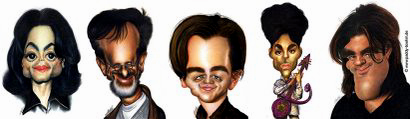
Hollywood Land's Five

Hollywood Land's Five
Mickey, Steve, Leo, Dwayne & Toño illustrated by Paddy Boehm
Showing posts with label Project for Films. Show all posts

Wednesday, March 21, 2007

The Secret

In some place, Afrika keep hiding away the ark

Sunday, December 24, 2006

Royal Treason

WHOEVER CONTROLS PRINCESS DIANA CONTROLS THE WORLD

Princess Diana and her soon-to-be husband, Dodi Fayed, were fatally injured in the Pont de l'Alma tunnel. The site is ancient, dating back to the time of the Merovingian kings (ca. 500 - 751 A.D.), and before. In pre-Christian times, the Pont de l'Alma was a pagan sacrificial site. Note that in the pagan connotation, at least, sacrifice is not to be confused with murder: the sacrificial victim had to be a willing participant.
In the time of the Merovingian kings, the Pont de l'Alma was an underground chamber. Founder of the Merovingian dynasty was Merovaeus, said to be descended from the union of a sea creature and a French queen. Merovaeus followed the pagan cult of Diana. In Middle English, "soul" (Alma) has as etymology "descended from the sea." "Pont," has as a Latin root "pontifex," meaning a Roman high priest. (See also pons, pontis -- bridge; passage.) "Alma" comes from the Latin "almus," meaning nourishing. One translation of Pont de l'Alma would be "bridge of the soul." Another would be "passage of nourishment." All true European royalty is descended from the Merovingians, which are believed to be descendants of Jesus Christ.
During the Merovingian era, if two kings had a dispute over property, it was settled in combat at Pont de l'Alma. According to legend, anyone killed there goes straight to Heaven and sits at the right hand of God, watching over all his foe was to do. The person killed in combat was actually considered to be the "winner," since he became God's eyes on earth and even could manipulate events.
The current British royal family are imposters. The House of Windsor is a fraud. But the lineage of Lady Diana Spencer goes back to Charles II of the House of Stewart. The House of Stewart is of *true* royal blood. Diana's sons, William and Harry, have 3-quarters true nobility in their blood.
Princess Diana was in a powerful position. Two main factions vied for control over her: (1) the New World Order faction, founded on an alliance between King William III (Bank of England, modern system of finance, and "national debt" all beginning during his reign) and later, the Rothschilds, and (2) the true nobility of Europe.
*Within* the New World Order faction, there are smaller, warring factions, exemplified by Rothschilds vs. Rockefellers. The plan of the New World Order faction was to marry Lady Diana to an American. Even though Bill Clinton has bastard roots in the Rockefeller clan, he is rejected by them and is aligned with the Rothschilds. Bill Clinton was the designated future husband for Lady Diana, with Hillary Clinton to be eliminated through divorce or even murder. The Rockefellers were furious; in no way would they allow a marriage between Bill Clinton and Lady Diana. In Great Britain, Prince William would be on the throne by age 25; if Prince Charles did not abdicate, he would be assassinated.
Then, Prince Harry and the living Lady Diana would have moved to the U.S. Harry would become a U.S. citizen and go into politics, becoming perhaps a U.S. Senator. By then, whoever controlled the two boys -- Prince William and Prince Harry -- would control the world.
But in her last visit to the White House, circa January 1997, Lady Diana informed Mr. Bill Clinton that in no way, shape, or form would she *ever* marry him. (While in America, Lady Diana also met with John Kennedy, Jr.) Diana chose, instead, to marry for love. (Jackie Kennedy married Aristotle Onassis for power; he could protect her.)
Dodi Fayed, beloved of Lady Diana, is a cousin of Adnan Khashoggi, a CIA asset involved in sales of arms to Iran -- he and Oliver North. Adnan Khashoggi is part of the Saudi royal family. Through marrying Dodi Fayed, Diana would have been marrying into the Saudi royal family. She might have had to convert to Islam.
British intelligence (MI-6) arranged the deaths of Lady Diana and Dodi Fayed. It was imperative that the Saudi royal family not have control over Diana. The driver of the ill-fated Mercedes was a "Manchurian candidate" (brainwashed tool), with connections to the French military. How did so much alcohol get into his system? Amounts suggested in mass media reports are truly staggering -- so much alcohol that the driver would have had to been carried to the car. The way it happened was, the driver was made to swallow special slowly-digestible balloons containing high-potency alcohol. While he drove, the balloons were slowly digested and he became dangerous behind the wheel.
But even within British intelligence there are factions. A rogue faction in MI-6, powerless to prevent the assassination, arranged for the deaths of Lady Diana and Dodi Fayed to happen at Pont de l'Alma. Cleverly, it was known that a death at that historic location would not only "send a signal"; it would eventually lead to the creation of a "Saint Diana." In Roman paganism, Diana is "Queen of Heaven," a triple-goddess. "Al-mah," in mideast language, means "moon goddess." One aspect of the Roman triple-goddess is the "lunar virgin." The *al-mahs* served as maidens of Diana, the lunar virgin. In France, the Cult of Diana was so powerful that it wasn't until the Middle Ages until the French gave up worship of the pagan goddess. The *true* Knights Templar (not to be confused with imposters) are sworn to protect the Merovingian blood -- i.e., that of the *true* royals, such as Lady Diana. Before too long, Project Blue Beam holographic imaging will be used to create "miraculous appearances" of Lady Diana. Children at various locations will be randomly selected to witness "saintly apparitions." These children will receive a "message" from "Diana." Some of the children will claim that "Diana" has given them healing powers -- and what is more, these children *will* be able to "heal." Locations of these "miraculous appearances" will become known as places of healing and sacred shrines. "Saint Diana's" two children, William and Harry, will become akin to two living Jesus Christs, walking the earth. It will be the start of "the new religion." Who controls the new religion controls the world.

Saturday, July 15, 2006

Leonardo DiCaprio as Dorian Gray

Dorian Gray was the orphaned grandson of Lord Kelso. His mother, Margaret Deveraux, a great society beauty, died in childbirth shortly after Dorian's father was killed in a duel. It was said that Lord Kelso paid a Belgian duelist to cause the fight.
The novel begins with Dorian as a young man. Kelso is dead, and Dorian has inherited much of the Deveraux fortune. He is now the protegé of Lady Agatha, Lord Henry Wotton's aunt, and together they entertain and raise money for the Whitechapel poor.
Until Dorian finally meets Lord Henry he is naïve of his own good looks and personality. His innocence is unspoiled and his knowledge of the world resembles that of a child. To his friend, the artist Basil Hallward, Dorian is inspiration, a privately worshipped icon in the painter's idealistic world. Dorian is described as "wonderfully handsome, with his finely-curved scarlet lips, his frank blue eyes and his crisp gold hair. . . . All the candour of youth was there, as well as all of youth's passionate purity."
One afternoon, while sitting for a portrait in Basil's studio, Dorian meets Lord Henry Wotton. Wotton's low musical voice enchants the lad as he stands upon a dais in the afternoon sunlight. Dorian is convinced by him that his looks are in fact his most important virtue.
The constant flick and dash of the artist's brush melt away, as Lord Henry's doctrine of self-development wakens Dorian to mad hungers. "The only way to get rid of a temptation is to yield to it . . ." murmurs Lord Henry. "Resist it and the soul grows sick with longing."
Dorian is transfixed by this philosophy. Flooded with feelings he cannot comprehend, he leaves the studio and goes out into the garden. Lord Henry joins him and under the shade of a laurel tree the boy listens to a second panegyric on youth: "The Laburnum will be as yellow next June as it is now. . . . But we never get back our youth. Our limbs fail, our senses rot. . . . Youth, youth, there is absolutely nothing in the world but youth."
When they return to the studio, Dorian is shown his finished portrait. On seeing it, the sense of his own beauty falls on him like a revelation. The full reality of Lord Henry's warning of the brevity of youth and life's aim of unbridled hedonism, cuts through Dorian's boyhood innocence. In a flash he cries:
I shall grow old, and horrible, and dreadful. But this picture will remain always young. It will never be older than this particular day of June. . . . If it were only the other way! If it were I who was to be always young, and the picture that was to grow old! For that—for that—I would give everything! Yes, there is nothing in the whole world I would not give! I would give my soul for that!
In the heat of the moment Hallward, astonished at Dorian's impassioned plea, attempts to destroy the canvas. But before the steel palette knife can do its work Dorian shouts, "No Basil, no . . . it would be murder!"
Under the guidance of
Lord Henry, Dorian becomes increasingly self-absorbed and heartless. Yet he discovers and falls in love with Sibyl Vane, a pretty actress. On the night of his introducing Basil and Lord Henry to her, the actress plays poorly; she is no longer able to act out the false love of Shakespeare's heroines whilst filled with a true love for Dorian. Disappointed and bitterly embarrassed for his friends, Dorian ends their relationship.
When the lad returns home at dawn, he notices a subtle change in the painting; there is a touch of cruelty in the mouth. As he looks curiously upon his image, he is unaware that that same night, with her engagement in ruins, Sibyl has committed suicide.
With the passage of time, the portrait ages and spoils. The hair thins, the cheeks grow sallow. It is clear the image is aging instead of Dorian. Incredibly, the portrait also bears burden of his shame.
Under Lord Henry's influence, Dorian continues to live a
hedonistic lifestyle, with strong hints of homosexual behaviour. The face of his portrait grows uglier with each moral transgression. Basil comes to warn Dorian of the scandalous rumours that are sweeping London about him. Wholly indifferent, Dorian smiles to himself, and decides to show Basil the painted "diary of his life". Hallward is perplexed as Dorian explains to him that not only God can see one's soul, "for tonight, with your own eyes, you will see my soul."
Together they go up to the old nursery at the top of the house, and as the purple pall is torn from Hallward's painting, the artist falls to his knees and begs Dorian to pray for forgiveness. The loathsome image is sickening. Every vile act, every hideous sign of age oozes from the canvas. Dorian picks up a discarded knife and in a fit of rage, murders his old friend. Blood immediately appears on the picture, staining the bloated hands of its subject. Turning from the scene, pressing his forehead to the cool glass of the window, with Hallward's blood still dripping on the carpet, Dorian determines to hide forever this monstrous mirror.
Towards the end of the novel, Dorian realizes he was wrong to have followed Lord Henry's doctrines. He decides to change, to make amends and to rise above his mentor's cynical epigrams that cut the beauty of life to pieces. But his attempts at reform are shallow and superficial -- and in turn the painting gains a cunning and
hypocritical look.
At last Dorian plans to rid himself of his terrible sins by destroying the portrait. Realizing that only a full confession will absolve him, yet fearing the consequences, he decides to kill the last vestiges of his conscience --for it is conscience that has brought him to where he stands now. He stabs the canvas. The servants hear a terrible scream and rush to the nursery, but:
When they entered, they found hanging upon the wall a splendid portrait of their master as they had last seen him, in all the wonder of his exquisite youth and beauty. Lying on the floor was a dead man, in evening dress, with a knife in his heart. He was withered, wrinkled, and loathsome of visage. It was not till they had examined the rings that they recognized who it was.


Dracula, The Cursed Templar


http://www.donlinke.com/drakula/vlad.htm

Saturday, July 01, 2006

Trojan Horse: The First Crusade

Caballo de Troya (Spanish for Trojan Horse) is a novel (the first of a series of eight) written in 1984 by Spanish journalist and ufologist J.J. Benítez, which became famous in Spanish-speaking countries and in Brazil, so far without an English translation.
It deals with a supposed successful attempt by
US military in 1973 to send time travellers back to Israel during the time of Jesus Christ, to witness his days of ministry by the year 30, and to a certain degree even interact with him and other people.
Benitez, born
September 7, 1946, in Pamplona, Navarre, northern Spain, got a journalism degree in 1965 and joined newspaper La Verdad of Murcia in January 1966. Over the next few years, he became interested in the UFO phenomenon, then sweeping headlines and bookshelves all along the western world, and he eventually left journalism in the late 1970s. He wrote in his website that he first became interested in the "real" life of Jesus around that time, when a team of researchers said that the Shroud of Turin showed traces of Jesus' body. These claims have later come under scrutiny, but the fact has not stopped the flow of new Caballo de Troya's books.
The author has claimed the time-travel part of Caballo de Troya is
fiction, but that it contains "more truth than people think" suggesting, given he purports to be "a UFO researcher", that he might be claiming alien contact. If Benítez had no further ambitions other than to remain confined within the realm of pure fiction, perhaps they would stand alone by whatever literary or imaginative merits they might have. But the author insists that most, if not all, events in his novels are real.

The book is narrated as if it is a true report of how the author was approached by an unnamed retired
US Air Force pilot, referred to as "The Major" in the book, who in an elaborated indirect way tells the author how to find classified documents telling the story of the Trojan Horse Operation, in which The Major took part as a time traveller sent to witness the last weeks of Jesus' life through a time-travelling device sent back in time by the US military in an Israel base in 1973.
A lengthy, detailed "technical" description of the time travel process ("inversion of
quantum swivels") is provided. The time-traveller and the time-travelling vehicle are said to have been wrapped by an artificial skin to avoid biological contamination. The Major, who becomes the narrator of the story, is called "Jason" during the mission, and learns some Aramaic and Greek.
It is "revealed" that many of the amazing stories of
eclipses, earthquakes after Jesus' death and his transfiguration were linked to extraterrestrial influences. Jesus' physical appearance is described as almost Nordic, with hazel eyes and very tall (he is sometimes called "The Giant", physically and metaphorically in the book).
Unlike the sequels the first Caballo de Troya is an intriguing
fiction story, written with some style and containing attractive plot twists. Even as the 1970s UFO mania has lost traction in Spanish-speaking countries, Benitez has retained solid sales and certain celebrity on the basis of his book series.
The following 7 sequels expand on the issued and reveal more detail. Caballo de Troya 8, Jordán was published in Spain recently.


Spiderman 3/Coming Soon/May 4, 2007