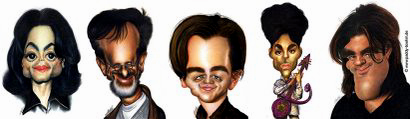
Hollywood Land's Five
Mickey, Steve, Leo, Dwayne & Toño illustrated by Paddy Boehm
Saturday, December 23, 2006
Saturday, December 16, 2006
Impossible is Nothing: Massu & Gonzalez's Odyssey
Post by Javier Krueger at 12/16/2006 01:34:00 pm 0 comentarios
Into The Conspiracy with Oliver Stone
Stone was born in New York City. His father was Jewish and his mother a Roman Catholic of French birth. He was raised an Episcopalian as a compromise.[1]At the age of 14, Stone's parents sent Stone away to attend high school at The Hill School, an exclusive college-preparatory school in Pottstown, Pennsylvania. His parents divorced while he was away at The Hill School, and only then did Stone learn of his father's extramarital affairs with the wives of several family friends. Stone graduated from this boarding school in 1964, the same year as former JP Morgan & Co. CEO, Douglas A. Warner III. Stone then attended Yale University and New York University. He attended Yale, dropping out after one year. He then taught English at the Free Pacific Institute in South Vietnam for six months after which he worked as a merchant marine, and traveled to Oregon and Mexico, before returning to Yale, where he dropped out a second time.
A veteran of the Vietnam conflict, Stone served with the United States Army from April 1967 to November 1968. He specifically requested combat duty and was assigned to the 25th Infantry Division and the 1st Cavalry Division, and was wounded twice in action. His personal awards include the Bronze Star with "V" device for valor for "extraordinary acts of courage under fire", and the Purple Heart with one Oak Leaf Cluster.
He has made three films about Vietnam —Platoon (1986), Born on the Fourth of July (1989), and Heaven & Earth (1993). He has called these films a trilogy, though they each deal with different aspects of the war. Platoon is a semi-autobiographical film about Stone's experience in combat. Born on the Fourth of July is based on the autobiography of Ron Kovic. Heaven & Earth is a true story of a Vietnamese girl whose life is drastically affected by the war.
Stone has won three Academy Awards. His first "Oscar" was for Best Adapted Screenplay for Midnight Express (1978). He won Academy Awards for Directing Platoon and Born on the Fourth of July. Other films whose screenplays he participated in are Conan the Barbarian (1982), Scarface (1983), Year of the Dragon (1985), 8 Million Ways to Die (1986) and Evita (1996). In addition, he has written or taken part in the writing of every film he has directed, except for U Turn (1997). The very first film that he directed professionally was the obscure horror picture Seizure (1974).
A distinct feature in Oliver Stone's movies is the use of a multitude of different cameras and film formats, from VHS to 8mm film to 70mm film. He sometimes uses several formats in a single scene, as in JFK (1991) and Natural Born Killers (1994).
Post by Javier Krueger at 12/16/2006 01:01:00 pm 0 comentarios
Sunday, September 03, 2006
Al Pacino as The Alchemist by Paulo Coelho
The Alchemist (Portuguese: O Alquimista) is a bestseller that was first published in Brazil in 1988 and is the most famous work of author Paulo Coelho. It is a symbolic story that urges its readers to follow their dreams. An alchemist traveling in a caravan in an unspecified place and time recounts a fable that he read along the way. The story is a modified version of the myth of Narcissus. The twist in this version is that the lake in which Narcissus drowns weeps for the death of Narcissus not because of his beauty, but because the lake could gaze at its own beauty in the eyes of the young boy. This idea is taken from a short prose-poem by Oscar Wilde called 'The Disciple'. Santiago, the protagonist, grows up with poor parents who struggled their whole lives to send him to seminary. But Santiago has a strong desire to travel the world, and so his father allows him to use his inheritance to buy a flock of sheep. As a shepherd, he spends several years traveling the countryside of Andalusia in southern Spain, enjoying the care-free and adventurous life of a wanderer. As the story begins, we learn that a year ago Santiago met the beautiful daughter of a merchant in a town he is soon to revisit. Even though he spent only a few hours talking with this girl, his strong feelings for her make him question his life as a shepherd and make him consider the merits of a more settled life. He sleeps in a church where a sycamore tree grew where the sacristy once was (refer to end).
When he arrives in the town where the girl lives, he first decides to go to a gypsy fortune-teller to help him decipher a recurring dream that he had been having. Santiago always dreams that a child is playing with his sheep and then takes him by the hand and brings him to the Pyramids of Egypt to show him the location of a hidden treasure. But Santiago always wakes up just before the child is going to reveal to him the exact location of the treasure. The gypsy says that he has to go because if it is a child that tells, it exists.
At first, the boy does not mind what the gypsy says, but when an old man, who calls himself Melchizedeck, the king of Salem, tells him that it is his Personal Legend or his purpose to live, he is interested. Melchizedeck tells him a wonderful story about a man who found true happiness by fulfilling his Personal Legend. The king gives the boy two stones, Urim and Thummim, one black and the other white, the black meaning "yes" and the white "no". These, he says, are for making decisions, although it is best to make them himself. Santiago decides to travel to Africa. He sells his sheep and goes to Tangier, a port in Africa near Spain. But in Tangier, he is robbed. Losing hope, he decides to walk about the city; up in a hill, and finds a crystal shop. He finds that business declined when the nearby city developed. When the boy enters the shop, he cleans the dusty crystal glasses in exchange for some food to eat. As he is cleaning two customers enter the store and buy some crystal glasses. The Arab merchant says that it is a good omen, and hires the boy. Santiago learns that every person's fate is written, and that there is a Language of the World (unspoken) learned partly by his dealings with his sheep.
After almost a year, the boy decides to leave the crystal shop since he has enough money to buy a flock of sheep twice the size of the one he had before, and since he has since learned Arabic, can sell to Arabic merchants too. But he never buys a single sheep. He decides to fulfill his personal legend - to find his treasure.
He joins a caravan going to the desert where the Pyramids are found. In the caravan, the boy meets an Englishman who for twenty years has searched for true alchemists. The Englishman has many books on alchemy that are unusual to the boy. In the caravan, he learns the language of the desert and the Soul of the World.
As the caravan rolls on toward the oasis, the two people in the caravan decide to learn from one another. As the Englishman attempts to observe the desert and learn its language, Santiago reads the Englishman's books and learns about alchemy. The Englishman tells him that the goal of alchemists is to purify metal by heating it for many years until all its individual properties are burned. After a while, Santiago stops reading and returns the books to the Englishman, and each tells the other he is not able to learn anything. Santiago concludes everyone has his or her own way of learning things.
When it arrives in the oasis, the caravan is welcomed and told that it will not be permitted to proceed further because of tribal wars. Santiago helps the Englishman look for the alchemist. He meets a desert woman named Fatima who tells the group where the alchemist lives. The boy is infatuated with Fatima's beauty at first sight, and tells her that he loves her and wants her to be his wife. At the very same time, the alchemist living at the oasis realizes that he will meet a disciple who would learn from him the secrets of alchemy. Apparently the disciple turns out to be Santiago.
Santiago meets the alchemist after averting a threat of tribal attack on the oasis through a vision he has after reading about the flight of two hawks. The alchemist tells the boy that he will never be happy unless he fulfills his Personal Legend. Reluctant to leave the oasis because of his love for the desert girl Fatima, Santiago tells the alchemist that he wants to stay there, accepting the new role of councilor which was offered to him by the chieftain when Santiago saved the oasis. But the alchemist warns Santiago that in the future he would lose his ability to see omens because he stopped listening to the omens that told him to find his treasure and fulfill his Personal Legend. As a result he would lose his position as the councilor and he would regret not pursuing his destiny of finding his treasure.
Eventually, Santiago decides to leave the oasis with the alchemist in pursuit of his treasure. While traveling through the desert, the boy learns from the alchemist. He learns that each person who fulfills his personal legend enhances the Soul of the World, and that the world is just here to show God's glory. The alchemist also tells the boy to listen to his heart and understand it so it will not betray him and tell him in fear that it is not wise to find his treasure. Santiago and his heart become one, and Santiago's heart tells him that he has learned the unspoken Language of the World.
Santiago and the alchemist are captured along the way by one of the warring tribes. The alchemist tells the chief that they have brought money to give to him. the money is accepted without question as it can buy many arms; the alchemist then declares that Santiago is a powerful alchemist and can turn himself into the wind and destroy the military encampment if he wants to. The leader demands to see this and tells the boy he has three days to demonstrate his power or the two will die. This is the ultimate test of Santiago's knowledge of alchemy. On the third day, Santiago leads the group to the top of a cliff and tells them that the action will take a while.
Using his knowledge of the Language of the World that he learned from his heart on his journey, Santiago talks to the desert, and teaches it about love, and eventually the desert allows Santiago to use his sands, saying that he would also need the wind to blow them. Santiago turns to the wind, and tells it that it hasn't met its full limits. The wind, curious about what it could do, strikes up a conversation about love with the boy. The wind is unsatisfied, and suggests the boy talk to the heavens (the sun). The boy tells the wind that it must blow the sands so he will not be blinded when looking at the sun. The boy proceeds to talk to the sun, and after the sun tells him that although he is wise, he doesn't know how to turn Santiago into the wind. The wind, overjoyed that he knows that the sun has its limits, blows even harder.
The "Sinum," the sandstorm that results, almost destroys the camp. Two commanders with the chief are fearful and tell him that they should stop this. The chief replies that he wishes to see the greatness of Allah, the Arabic word for God, and makes a mental note to remove the two from command as true desert men are not afraid. Santiago is told to talk to the hand that wrote all, that is, the Son of God. The boy and the Son of God have a silent conversation, and the soul of the boy becomes one with the Soul of the World, which is the Soul of God. The Soul of God can perform miracles, and Santiago turns himself into the wind and moves off the cliff to the far side of the camp next to a sand-covered sentinel.
After turning himself to wind, Santiago and the alchemist travel on to the pyramids with an escort party provided by the general-chief. They stop at a monastery, and the alchemist tells the escort party to return to their camp. There he meets a monk and they talk in the Coptic tongue. The monk invites them in. In the kitchen, the alchemist shows Santiago a demonstration of turning a pot of lead into gold. The alchemist divides the gold into four quarters and gives the monk one of the pieces for his generosity and hospitality. He gives a piece to Santiago, and one for him to return to the oasis. He gives the final piece to the monk for Santiago in case he ever needs it. Santiago and the alchemist separate not far from the pyramids. Santiago's heart tells him that he should dig for his treasure where he weeps after getting to the pyramids of joy.
Robbed once again near the pyramids, Santiago gives up hope, but the robber tells him that he is stupid to have traveled so far. He then tells the boy of a recurring dream in which he had seen a treasure in a church where shepherds and their sheep slept, hidden under a sycamore tree growing where the sacristy once was. The boy, who slept in this church as a shepherd himself at the beginning of his adventures, goes back to the monk to get money for the return trip and finds the treasure, a chest of Spanish gold coins.
The idea for this story is taken from a short prose-poem by Oscar Wilde called 'The Disciple'.
Post by Javier Krueger at 9/03/2006 03:49:00 pm 0 comentarios
Johnny Depp as the real Dracula
Vlad III the Impaler (Vlad Ţepeş IPA: ['tsepeʃ] in common Romanian reference; also known as Vlad Dracula or Vlad Drăculea and Kazıklı Bey in Turkish; November or December, 1431 – December 1476) was Prince (voivode) of Wallachia, a former polity which is now part of Romania. His three reigns were in 1448, 1456–62, and 1476. In the English-speaking world, Vlad is best known for the legends of the exceedingly cruel punishments he imposed during his reign, and serving as the primary inspiration for the vampire main character in Bram Stoker's popular Dracula novel. As Prince, he led an independent policy in relation to the Ottoman Empire, and in Romania he is viewed by many as a prince with a deep sense of justice[1] and a defender of Wallachia against Ottoman expansionism.Post by Francisco Krueger at 9/03/2006 02:49:00 PM
"Depp Steps into Shadows"
by Josh Grossberg
Johnny Depp has never shied away from dark films like Dead Man, The Ninth Gate, Sleepy Hollow and From Hell. Now he's really found a role he can sink his teeth into. The actor is teaming with Warner Bros. on a movie version of the classic supernatural soap opera Dark Shadows, with Depp playing lead vampire Barnabas Collins. Depp has long counted himself among the legion of Dark Shadows devotees and has stated in past interviews that he's dreamed of playing Barnabas ever since he was a kid. Through their respective production companies, Depp and Graham King purchased the rights to the spooky ABC serial from the estate of the show's mastermind, Dan Curtis, according to Variety.The groundbreaking Dark Shadows ran for 1,125 episodes from 1966 to 1971, chronicling the strange goings-on around the mysterious Collins family in their estate in Maine. Populated by myriad macabre characters, including vampires, witches, werewolves, ghosts and zombies, the show spawned a cult following, numerous fan conventions and various attempts to resurrect the program after the network put a stake in it. Curtis directed House of Dark Shadows, a 1970 movie adaptation starring Jonathan Frid, who originated Barnabas in the series. Curtis later updated Shadows in 1990 with a new TV series that lasted one season with Ben Cross in the immortal role. Another short-lived remake, not supervised by Curtis, featured Alec Newman as the head vampire and aired in 2004.
Warners is currently teaming with the Pirates of the Caribbean star on a biopic about the life of Alexander Litvinenko, the former KGB agent and expatriate whose poisoning last November has poisoned relations between Great Britain and Russia. Depp is also working with the studio's art-house arm, Warner Independent, to do his best Hunter S. Thompson impersonation for The Rum Diary. The film, based on the gonzo iconoclast's autobiographical novel about his experiences as a young reporter in Puerto Rico, will be Depp's second go at a Thomspon work, having previously played him in Fear and Loathing in Las Vegas. King and Depp will produce the film from a screenplay by Bruce Robinson (Withnail and I).
Meanwhile, Depp and frequently collaborator Tim Burton recently wrapped production on the movie adaptation of the Broadway musical Sweeney Todd. Next up for the actor is the lead role in Mira Nair's drug-themed Shantaram.
The Dark Shadows news was just one tidbit to emerge from Warners' presentation at Comic-Con in San Diego on Friday, as the studio offered previews of some of its highest profile 2008 releases.
Steve Carrell and Dwayne "The Rock" Johnson were on hand to hype their action-comedy adaptation of the classic Don Adams TV spy comedy, Get Smart.
Nicole Kidman appeared via a taped message to plug The Invasion, a reimagining of 1956's Invasion of the Body Snatchers, directed by Oliver Hirschbiegel and costarring Daniel Craig.
Kate Beckinsale was on hand to fill in the fanboys on her new thriller Whiteout, in which she plays a federal agent hunting a vampire killer in Antarctica as the sun is about to set for six months.
Überproducer Joel Silver turned up to answer questions about Whiteout and his upcoming Speed Racer movie.
Warners showed also trailers for director Roland Emmerich's latest B-movie extravaganza, the prehistoric epic 10,000 B.C.; Anna Paquin's campy horror flick, Trick or Treat; and the supernatural thriller One Missed Call, starring Ed Burns and Shannyn Sossamon.
One highly anticipated Warner Bros. release that was MIA was Batman: The Dark Knight, Christopher Nolan's sequel to 2005's box-office hit Batman Begins, featuring Christian Bale as the Caped Crusader. Dark Knight will see him face off against Heath Ledger, playing a youthful Joker, while Aaron Eckhart appears as Harvey Dent, aka Two Face. There were, however, numerous Batman-related viral marketing stunts, such as the mysterious dollar bills that have been showing up around the convention area with George Washington sporting black and blue eyes and a manic lipstick smile above the phrase "Why So Serious?" A number of teaser Websites have also gone up online including whysoserious.com.
Warners execs did give comic book aficionados something of a consolation prize. The studio unveiled the cast of 300 helmer Zack Snyder's big-screen adaptation of the popular graphic novel The Watchmen, including Billy Crudup, Patrick Wilson, Matthew Goode and Jackie Earle Haley, the former Bad News Bear who scored an Oscar nod for his comeback role in last year's Little Children.
Finally, Warner Bros.' sister studio, New Line Cinema, announced that Vince Vaughn and Reese Witherspoon are teaming up for the holiday comedy Four Christmases, about a couple attempting to visit all four divorced parents on Christmas Day. Shooting is expected to get underway this fall.
Post by Javier Krueger at 9/03/2006 02:49:00 pm 0 comentarios
Saturday, August 26, 2006
The Da Vinci Code
The Da Vinci Code is a mystery/detective novel by American author Dan Brown, published in 2003 by Doubleday.This novel has provoked popular interest in speculation concerning the Holy Grail legend and the role of Mary Magdalene in the history of Christianity. According to the premise of the novel, the Vatican knows it is perpetuating a lie about Jesus' bloodline and the role of women in church, but continues to do so to keep itself in power.
Dan Brown's novel was a major success in 2004 and at times it was only outsold by the highly popular Harry Potter series. It spawned a number of offspring books and drew glowing reviews from the New York Times, People Magazine and the Washington Post.[2] It also re-ignited interest in the history of the Roman Catholic Church. As well as re-invigorating interest in the Church, The Da Vinci Code, itself preceded by other Grail books such as The Holy Blood and the Holy Grail by Michael Baigent and others, and Umberto Eco's Foucault's Pendulum, has inspired a number of novels very similar to it, including Raymond Khoury's The Last Templar, and The Templar Legacy by Steve Berry.
It is a worldwide bestseller which had printed 60.5 million copies by May 2006 and has been translated into 44 languages. It is thought to be the fourteenth best-selling book of all time. Combining the detective, thriller and conspiracy fiction genres, the book is the second book by Dan Brown to include the character Robert Langdon, the first being his 2000 novel Angels and Demons. In November 2004 Random House published a "Special Illustrated Edition" with 160 illustrations.
In 2006, a film adaptation, The Da Vinci Code, was released by Columbia Pictures.
The book describes the attempts of Robert Langdon, Professor of Religious Symbology at Harvard University, to solve the murder of renowned curator Jacques Saunière (see Bérenger Saunière) of the Louvre Museum in Paris. The title of the novel refers, among other things, to the fact that Saunière's body is found in the Denon Wing of the Louvre naked and posed like Leonardo da Vinci's famous drawing, the Vitruvian Man, with a cryptic message written beside his body and a Pentacle drawn on his stomach in his own blood.
The interpretation of hidden messages in Leonardo's famous works, (which relate to the concept of the Sacred feminine) including the Mona Lisa and The Last Supper, figure prominently in the solution to the mystery.
The novel has several concurrent subplots interweaving the lives of different characters. Eventually all the characters are brought together and the subplots resolved in the denouement. The unraveling of the mystery requires the solution to a series of brain-teasers, including anagrams and number puzzles. The ultimate solution is found to be intimately connected with the possible location of the Holy Grail and to a mysterious society called the Priory of Sion, as well as to the Knights Templar. The story also involves the Roman Catholic organization Opus Dei.The novel is the second book by Brown in which Robert Langdon is the main character. The previous book, Angels and Demons, took place in Rome and concerned the Illuminati. Although Angels and Demons is centered on the same character the plots are not dependent upon each other. The next book is tentatively scheduled for release in 2008. Its title is The Solomon Key, and it is understood to concern Freemasonry[citation needed].
Characters and their involvement in The Da Vinci Code
These are the principal characters that drive the plot of the story. Some have names that are puns, anagrams or hidden clues:
Robert Langdon
Jacques Saunière
Sophie Neveu
Bezu Fache
Silas
Bishop Manuel Aringarosa
André Vernet
Sir Leigh Teabing
Rémy Legaludec
Lieutenant Jérôme Collet
Guardian of the Rosslyn Trust
Apparently, the relationship between Langdon and Vittoria Vetra from Angels and Demons has ended. The full message Saunière wrote on the floor of the Louvre contained the line "P.S. Find Robert Langdon". This was the reason Bezu Fache suspected Langdon of being the murderer. Fache had erased this line before Langdon arrived so that Langdon would not be aware that the police suspected him. Sophie Neveu saw the entire text of the message when it was faxed to her office by the police. Sophie realized immediately that the message was meant for her, since her grandfather used to call her "Princess Sophie" (i.e. "PS"). From this, she also knew Langdon to be innocent. She informs him of this secretly when they are in the Louvre by having him call her personal voicemail box and listen to the message that she had left there for him.
At the end of the book, Robert Langdon and Sophie Neveu seem to be falling in love. They arrange to meet in Florence as Robert and Vittoria did in Angels and Demons.
Jacques Saunière was the Grand Master of the Priory of Sion and therefore knew the hidden location of the "keystone", which leads to the Holy Grail and documents which would shake the foundation of Christianity and the Church. He was killed in an attempt to extract this information from him and eliminate the top members of the Priory of Sion.
The reason that Sophie Neveu disassociated herself from her grandfather is that she discovered him participating in a pagan sex ritual (Hieros Gamos) at his home in Normandy, when she made a surprise visit there during a break from boarding school. (That she had observed something was mentioned but what it was that she saw was revealed to no one, including the reader, until near the end when she revealed it to Robert.)
The other three lines of Saunière's blood message are anagrams. The first line are the digits of the Fibonacci sequence out of order. The second and third lines ("O, Draconian devil!" and "Oh, lame saint!") are anagrams respectively for "Leonardo da Vinci" and "The Mona Lisa" (in English). These clues were meant to lead to a second set of clues. On the glass over the Mona Lisa Saunière wrote the message "So dark the con of Man" with a curator's pen that can only be read in ultra-violet light. This clue is an anagram for Madonna of the Rocks, another Da Vinci painting hanging nearby. Behind this painting, Saunière hid a key. On the key, written with the curator's pen, is an address.
The key opens a safe deposit box at the Paris branch of the Depository Bank of Zurich. Saunière's account number at the bank is a 10-digit number listing the digits of the first eight Fibonacci numbers: 1 1 2 3 5 8 13 21.
The instructions that Saunière revealed to Silas at gunpoint are actually a well-rehearsed lie, namely that the keystone is buried in the Church of Saint-Sulpice beneath an obelisk that lies exactly along the ancient "Rose Line" (the former Prime Meridian which passed through Paris before it was redesignated to pass through Greenwich). The message beneath the obelisk simply contains a reference to a passage in the Book of Job (38:11a, KJV) which reads in part "Hitherto shalt thou go and no further". When Silas reads this, he realizes he has been duped.
The keystone is actually a cryptex, a cylindrical device supposedly invented by Leonardo Da Vinci for transporting secure messages. In order to open it the combination of rotating components must be arranged in the correct order. If the cryptex is forced open an enclosed vial of vinegar ruptures and dissolves the message, which was written on papyrus. The rosewood box containing the cryptex contains clues to the combination of the cryptex, written in backwards script in the same manner as Leonardo's journals. While fleeing to England aboard Teabing's plane, Langdon solves the riddle and finds the combination to be "S-O-F-I-A".
The keystone cryptex actually contains a second smaller cryptex with a second riddle that reveals its combination. The riddle, which says to seek the orb that should be on the tomb of "a knight a pope interred", refers not to a medieval knight, but rather to the tomb of Sir Isaac Newton, who was buried in Westminster Abbey, and was eulogized by Alexander Pope (A. Pope). The missing orb refers to the apple which, in popular legend, fell on Newton and inspired the development of his theory of gravity, therefore the combination to the second cryptex is "A-P-P-L-E".
The Teacher is Sir Leigh Teabing. He learns of the identities of the leaders of the Priory of Sion, bugs their offices and has Silas assassinate them. Rémy is his collaborator. It is Teabing who contacted Bishop Aringarosa, hiding his identity, and duped him into financing the plan to find the Grail. He never intended to hand the Grail over to Aringarosa but is taking advantage of Opus Dei's resolve to find it. Teabing believes that the Priory of Sion has broken its vow to reveal the secret of the Grail to the world at the appointed time. and plans to steal the Grail documents and reveal them to the world himself. It was he who informed Silas that Langdon and Sophie Neveu were at his chateau. He did not seize the keystone from them himself because he did not want to reveal his identity. He summoned Silas to seize the keystone in his house, but himself thwarted Silas, in order to gain Langdon and Sophie's further help with decoding the cryptex. Subsequently, the police raided the house, having followed the tracking device in the truck Langdon had stolen. Teabing led Neveu and Langdon to the Temple Church in London, knowing full well that it was a dead end, in order to stage the hostage scene with Rémy and thereby obtain the keystone without revealing his real plot to Langdon and Neveu. The call Silas received while riding in the limousine with Rémy is in fact Teabing, surreptitiously calling from the back of the limousine.
In order to erase all knowledge of his work, Teabing kills Rémy by giving him cognac laced with peanut powder, knowing Rémy has a deadly allergy to peanuts. Thus, Rémy dies of an anaphylactic shock. Teabing also anonymously tells the police that Silas is hiding in the London headquarters of Opus Dei.
In a showdown with Teabing in Westminster Abbey, Langdon secretly opens the second cryptex and removes its contents before destroying it in front of Teabing. Teabing is arrested and led away while fruitlessly begging Langdon to tell him the contents of the second cryptex and the secret location of the Grail.
Bishop Aringarosa and Silas believe they are saving the Church, not destroying it.
Bezu Fache figures out that Neveu and Langdon are innocent after discovering the bugging equipment in Teabing's barn.
Silas accidentally shoots Aringarosa outside the London headquarters of Opus Dei while fleeing from the police. Realizing his terrible error and that he has been duped, Aringarosa tells Bezu Fache to give the bearer bonds in his briefcase to the families of the murdered leaders of the Priory of Sion. Silas dies of fatal wounds.
The final message inside the second keystone actually does not refer to Rosslyn Chapel, although the Grail was indeed once buried there, below the Star of David on the floor (the two interlocking triangles are the "blade" and "chalice", i.e., male and female symbols).
The docent in Rosslyn Chapel is Sophie's long-lost brother.
The guardian of Rosslyn Chapel, Marie Chauvel, is Sophie's long-lost grandmother, and the wife of Jacques Saunière. She is the woman who participated in the sex ritual with Jacques Saunière.
Even though all four of the leaders of the Priory of Sion are killed, the secret is not lost, since there is still a contingency plan (never revealed) which will keep the organization and its secret alive.
The real meaning of the last message is that the Grail is buried beneath the small pyramid (i.e., the "blade", a male symbol) directly below the inverted glass pyramid of the Louvre (i.e., the "chalice", a female symbol, which Langdon and Sophie ironically almost crashed into while making their original escape from Bezu Fache). It also lies beneath the "Rose Line," which is similar to "Rosslyn." Langdon figures out this final piece to the puzzle in the last pages of the book, but he does not appear inclined to tell anyone about this. See La Pyramide Inversée for further discussion.
As explained by Leigh Teabing to Sophie Neveu, the figure at the right hand of Jesus is supposedly not the apostle John, but Mary Magdalene. According to the book Mary Magdalene was the wife of Jesus Christ and was in fact pregnant with his child when Jesus was crucified. The absence of a chalice in the painting supposedly indicates that Leonardo knew that Maria Magdalene was actually the Holy Grail (the bearer of Jesus' blood). This is said to be reinforced by the letter "V" that is created with the bodily positions of Jesus and Mary, as "V" is the symbol for the sacred feminine. The apparent absence of the "Apostle John", under this interpretation, is explained by identifying John as "the Disciple Jesus loved", allegedly code for Mary Magdalene (see also Second Apocalypse of James). The book also notes that the color scheme of their garments are inverted: Jesus wears a red blouse with royal blue cape; John/Mary wears a royal blue blouse with red cape — perhaps symbolizing two bonded halves of marriage. Also, if you move John/Mary to right of Jesus, you will see his head fits perfectly onto Jesus' shoulder as if to lay her head on his shoulder.
According to the novel, the secrets of the Holy Grail, as kept by the Priory of Sion, are as follows:
The Holy Grail is not a physical chalice, but a woman, namely Mary Magdalene, who carried the bloodline of Christ.
The Old French expression for the Holy Grail, San gréal, actually is a play on Sang réal, which literally means "royal blood" in Old French.
The Grail relics consist of the documents that testify to the bloodline, as well as the actual bones of Mary Magdalene.
The Grail relics of Mary Magdalene were hidden by the Priory of Sion in a secret crypt, perhaps beneath Rosslyn Chapel.
The Church has suppressed the truth about Mary Magdalene and the Jesus bloodline for 2000 years. This is principally because they fear the power of the sacred feminine in and of itself and because this would challenge the primacy of Saint Peter as an apostle.
Mary Magdalene was of royal descent (through the Jewish House of Benjamin) and was the wife of Jesus, of the House of David. That she was a prostitute was slander invented by the Church to obscure their true relationship. At the time of the Crucifixion, she was pregnant. After the Crucifixion, she fled to Gaul, where she was sheltered by the Jews of Marseille. She gave birth to a daughter, named Sarah. The bloodline of Jesus and Mary Magdalene became the Merovingian dynasty of France.
The existence of the bloodline was the secret that was contained in the documents discovered by the Crusaders after they conquered Jerusalem in 1099 (see Kingdom of Jerusalem). The Priory of Sion and the Knights Templar were organized to keep the secret.
The secrets of the Grail are connected, according to the novel, to Leonardo Da Vinci's work as follows:
Leonardo was a member of the Priory of Sion and knew the secret of the Grail. The secret is in fact revealed in The Last Supper, in which no actual chalice is present at the table. The figure seated next to Christ is not a man, but a woman, his wife Mary Magdalene. Most reproductions of the work are from a later alteration that obscured her obvious female characteristics.
The androgyny of the Mona Lisa reflects the sacred union of male and female which is implied in the holy union of Jesus and Mary Magdalene. Such parity between the cosmic forces of masculine and feminine has long been a deep threat to the established power of the Church. The name Mona Lisa is actually an anagram for "Amon L'Isa", referring to the father and mother gods of Ancient Egyptian religion (namely Amun and Isis).
A number of different authors also speculate about the possibility of Jesus becoming a father. There are at least three children attributed to him, a daughter Tamar, born before the Crucifixion, and two sons Jesus (the Jesus Justus from the New Testament) and Josephes, both born after the Resurrection. Although their names are now part of the common culture of conspiracy writers, only two decades ago, when Holy Blood, Holy Grail was written, the names were not mentioned. The royal descents that lie at the heart of The Da Vinci Code mystery centre on the family of Josephes, who is supposed to be the grandfather of Aminadab del Graal, first of the "Fisher Kings". However the genealogies that are quoted in Grail lore appear to record too few generations, with children regularly being born to fathers in their 40s.
Part of the advertising campaign for the novel was that the artwork in the American version of the bookjacket held various codes, and that the reader who solved them via the author's website would be given a prize. Several thousand people actually solved the codes, and one name was randomly chosen to be the winner, with the name announced on live television, Good Morning America, in early 2004. The prize was a trip to Paris.
The five hidden puzzles reveal
That the back of the book jacket conceals latitude and longitude coordinates, written in reverse, light red on dark red. Adding one degree to the latitude gives the coordinates of the headquarters of the Central Intelligence Agency in Northern Virginia, which is the location of a mysterious sculpture called Kryptos. The coordinates were taken from part of the decrypted text of part 2 of the sculpture (part 4 has never been solved). When Brown has been asked why the coordinates are one degree off, his reply has been, "The discrepancy is intentional".
Bold letters are present on the book jacket. There is a secret message hidden in the text of the book flaps. The message: Is there no help for the widow's son (a reference to Freemasonry).
The words "only WW knows" can be seen on the back cover. It is a phrase printed invertedly, in the torn part of the book cover. This too is a reference to part 2 of the Kryptos sculpture.
A circle with numbers, between the Doubleday logo and the barcode, reveals a secret message. These are the chapter numbers where the initial letters are arranged in Caesar box format.
There is reverse writing on the cover of the book, which is the riddle for the first cryptex.
Brown, both via his website and in person, has stated that the puzzles in the bookjacket give hints about the subject of his next novel, The Solomon Key. This repeats a theme from his earlier novels. For example, Deception Point had an encrypted message which, when solved, said, "The Da Vinci Code will surface".
In the simplified Chinese version of The Da Vinci Code, the cover has a secret text; however, this text can be easily seen. It reads: "13-3-2-1-1-8-5 O, Draconian devil! Oh, Lame Saint! P.S. Find Robert Langdon." This is the multiply encrypted clue written in invisible ink next to the dead body in the museum which kicks off the plot of the entire novel.
Direct inspiration
The novel is part of the exploration of alternative religious history. Its principal source book is listed as per the court case, Lynn Picknett and Clive Prince's The Templar Revelation, as well as the books by Margaret Starbird. Holy Blood, Holy Grail (which is explicitly named, among several others, at the beginning of chapter 60), was stated by Dan Brown not to be amongst his primary research material for the book. It has been claimed that The Da Vinci Code is a romanticised version of this work, which was itself based on a series of documentaries that ran on the BBC in the 1970s, all written and/or directed by Henry Lincoln. The main similarity includes the idea that the Merovingian kings of France were descendants from the bloodline of Jesus Christ and Mary Magdalene. In reference to Richard Leigh and Michael Baigent (two of the authors of Holy Blood, Holy Grail), Brown named the principal Grail expert of his story "Leigh Teabing" (an anagram of "Baigent Leigh"). Brown confirmed this during the court case. In reply to the suggestion that Lincoln was also referenced, as he has medical problems resulting in a severe limp, like the character of Leigh Teabing, Brown stated he was unaware of Lincoln's illness and the correspondence was a coincidence. After losing before the High Court in July 12, 2006, Michael Baigent and Richard Leigh appealed, unsuccessfully, to the Court of Appeal. Following the trial, it was found that the publicity had actually significantly boosted UK sales of Holy Blood, Holy Grail.
Brown has reworked themes and characters from his own earlier novel Angels and Demons, specifically the main character, Robert Langdon.
European readers and critics noted some striking similarities between the "Da Vinci Code" and a Norwegian novel, "Sirkelens ende" ("Circle's End") by Tom Egeland, published in 2001 (two years before the Da Vinci code). Like the "Da Vinci Code", "Circle's End" involves an ancient mystery and a worldwide conspiracy, the discovery that Jesus was married to Mary Magdalene, and an albino as one of the central characters. In both novels, the main female character turns out to be the last living descendant of Christ and Mary Magdalene, and the daughter/granddaughter of the last grand master of a secret order. Many European readers have speculated that Dan Brown had plagiarized Tom Egeland's book. Since the Norwegian novel has not been translated into English, it is generally assumed today that the similarities between the two books, although striking, are coincidental. The author himself, Tom Egeland, has in numerous interviews in European media dismissed the claim of Brown's novel plagiarizing his own novel, stating that the similarities just show that he and Brown more or less have done the same research and found the same sources.
Indirect inspiration
Umberto Eco's earlier Foucault's Pendulum also deals with conspiracies, codes, a chase around the monuments of Paris, including the Holy Blood conundrum (which is mentioned in passing) and the Knights Templar, but does so in a more critical fashion — it is in fact a satire about the futility of conspiracy theories and the people who believe them. Foucault's Pendulum has since been dubbed "the thinking man's The Da Vinci Code".
Foucault's Pendulum itself is reminiscent in plot, theme and structure to the earlier The Illuminatus! Trilogy, by Robert Shea and Robert Anton Wilson, published 13 years earlier.
Opus Dei was then cast in the role of the "evil opposition", used to destroy the bloodline. As the bloodline has never proven to be real, but merely a theory proposed in "The Holy Blood and the Holy Grail", there is no direct inspiration for this. It is believed Opus Dei's alleged controversial past allowed Brown to weave the organisation into his novel. On a symbolic level, the Priory of Sion (male and female membership and leadership, "good") and the Opus Dei (male-only leaders, "bad") are at opposite sides of the scale. The latter is thus depicted as the attack dog of the Catholic Church, seeking to destroy the former and maintain the status quo. According to the novel, man needs woman for wholeness and, in fact, for experiencing the divine by means of sex (see the Hieros Gamos ritual)--for example, in one's orgasm, there is a short period of time when a person's mind is completely empty, when one makes contact with God.
Main article: Criticisms of The Da Vinci Code
The book generated criticism when it was first published, due to speculations and misrepresentations of core aspects of Christianity, the history of the Catholic Church, and descriptions of European art, history, and architecture. The book has received mostly negative reviews from Catholic and other Christian communities, as well as historians.
On February 22, 2004, an article titled "The Last Word: The Da Vinci Con" appeared in the New York Times by writer Laura Miller. Miller attacks the Da Vinci Code on multiple levels referring to it as "based on a notorious hoax", "rank nonsense", and "bogus", as she points out how heavily the book rests on the fabrications of Pierre Plantard (including the Priory of Sion which didn't exist until Plantard created it) who in 1953 was arrested and convicted for just such frauds.
Critics accuse Brown of distorting and fabricating history. For example, Marcia Ford wrote:
"Regardless of whether you agree with Brown's conclusions, it's clear that his history is largely fanciful, which means he and his publisher have violated a long-held if unspoken agreement with the reader: Fiction that purports to present historical facts should be researched as carefully as a nonfiction book would be".
Richard Abanes wrote:
"The most flagrant aspect … is not that Dan Brown disagrees with Christianity but that he utterly warps it in order to disagree with it --- to the point of completely rewriting a vast number of historical events. And making the matter worse has been Brown's willingness to pass off his distortions as ‘facts' with which innumerable scholars and historians agree".
The book opens with the claim by Dan Brown that "The Priory of Sion- A European secret society founded in 1099- is a real organization" and that "all descriptions of artwork, architecture, documents [...] and secret rituals in this novel are accurate"; but this claim is disputed by almost all academic scholars in the fields the book discusses. The Priory of Sion itself was not a real secret society established in 1099 but actually a hoax created in 1956 by a Mr. Pierre Plantard.
As widely noted in the media, there has been substantial confusion among readers about whether the book is factual. Numerous works have been published that explain in detail why any claim to accuracy is difficult to substantiate, while two lawsuits have been brought alleging plagiarism in The Da Vinci Code. The second, by the authors of Holy Blood, Holy Grail claiming textual infringement of copyright, was found in Dan Brown's favor.
Dan Brown himself dilutes the suggestion of some of the more controversial aspects being fact on his web site: "The "FACT" page makes no statement whatsoever about any of the ancient theories discussed by fictional characters. Interpreting those ideas is left to the reader." However, it also says that "these real elements are interpreted and debated by fictional characters", "it is my belief that some of the theories discussed by these characters may have merit." and "the secret behind The Da Vinci Code was too well documented and significant for me to dismiss." It is therefore entirely understandable why there would continue to be confusion as to what is the factual content of the book.
Brown's earlier statements about the accuracy of the historical information in his book, however, were far more strident. In 2003, while promoting his novel, he was asked in interviews what parts of the history in his novel actually happened. He replied "Absolutely all of it." In a 2003 interview with CNN's Martin Savidge he was again asked how much of the historical background was true. He replied, "99 percent is true ... the background is all true". Asked by Elizabeth Vargas in an ABC News special if the book would have been different if he had written it as non-fiction he replied, "I don't think it would have." More recently Brown has avoided interviews and has been rather more circumspect about the accuracy of his claims in his few public statements. He has also, however, never retracted any of his earlier assertions that the history in the novel is accurate, despite substantial academic criticism of his claims.
In 2005, UK TV personality Tony Robinson edited and narrated a detailed rebuttal of the main arguments of Dan Brown and those of Baigent, Leigh and Lincoln, "The Real Da Vinci Code", shown on British TV Channel 4. The program featured lengthy interviews with many of the main protagonists cited by Brown as "absolute fact" in The Da Vinci Code. Arnaud de Sède, son of Gérard de Sède, stated categorically that his father and Plantard had made up the existence of the Prieuré de Sion, the cornerstone of the Jesus bloodline theory - to quote Arnaud de Sede in the program, "frankly, it was piffle". The program also cast severe doubt on the Rosslyn Chapel association with the Grail and on other related stories like the alleged landing of Mary Magdalene in France.
US Catholic bishops launched a website rebutting the key claims in the novel. The bishops are concerned about serious mis-statements in The Da Vinci Code.
Lots of linking to the name Pierre, Pierre Cartier, Pierre Peugeot, St Pierre (PS), Pierre-Auguste Renoir, Pierre Plantard, Victor hugo's Pierre, Pierre L'Enfant, Simple Plan's Pierre, Leonardo di ser Piero(PIERRE), Pierre Jeanniot, Pierre de Coubertin, Pierre(Copyright holder of Code joining blade and chalice), Pierre de Saint-Clair, bottle of Perrier is an anagram of Pierre, Grand-Pere(PIERRE), Hotel Ritz's Pierre, Priory of Sion's Pierre, Henry Lincoln's Pierre, Michael Baigents Pierre, Richard Leigh's Pierre, Pierre De France, Pierre's Dossiers secrets,Rennes le-Chateau's Pierre, Pierre De Cherisey, Pierre and Marie Curie Lived near Silis's Place , Architect's Pierre(monuments and buildings), Grand Master Pierre, Bloodline of Pierre's, Merovingian bloodline of Pierre's, even more but Dan never used HBHG's Pierre? Never once mentions Pierre? Yes he does! In picture version if you look closely on map it shows the name Avenue Pierre Semard near Ivry-ser-Seine.
Portrayal of Gnostic Christianity
According to The Da Vinci Code, the Roman Emperor Constantine I suppressed Gnostic Christianity because it portrayed Jesus as purely human. The novel's argument is as follows. Constantine wanted Christianity to act as a unifying religion for the Roman Empire. He thought Christianity would appeal to pagans only if it featured a demigod similar to pagan heroes. According to the Gnostic Gospels, Jesus was a merely human prophet, not a demigod. Therefore, to change Jesus' image, Constantine destroyed the Gnostic Gospels and promoted the gospels of Matthew, Mark, Luke, and John, which portray Jesus as divine or semidivine.
Historically, however, Gnostic Christianity did not portray Jesus as merely human. Some Gnostic writings do depict Jesus interacting with his disciples in a wholly human way, one example being the Gospel of Mary, but the general Gnostic depiction of Jesus is not clear-cut. Other Gnostic writings depict Christ as purely divine, his human body being a mere illusion (see Docetism). (Some Gnostic sects saw Christ this way because they regarded matter as evil, and therefore believed that a divine spirit would never have taken on a material body) It should be remarked that the category of 'gnosticism' includes a wide variety of beliefs and practices, and generalizing about them can therefore be misleading; indeed, early Christianity itself, even outside of Gnosticism, was a highly innovative and varying movement.
Post by Javier Krueger at 8/26/2006 05:41:00 pm 4 comentarios