The Passion of Christ
 The film opens (in medias res) with Jesus in the midst of an agonizing struggle about whether to go through with the crucifixion in the Garden of Gethsemane, on the Mount of Olives. He temporarily leaves prayers, and finds Peter, James, and John sleeping against a tree. Jesus wakes them and asks why they could not watch one hour with him. They respond with concern, asking whether they should summon the other Apostles. Jesus responds that he does not want them to see him in such a horrid condition and tells them to keep watching and to pray.
 Judas Iscariot meets with the Sanhedrin. Caiaphas, the High Priest (see Kohen Gadol), offers Judas, as is their agreement, thirty silver pieces to reveal where Jesus is. Judas accepts. We return to Gethsemane and Jesus praying, where we see he is being tempted by Satan (portrayed here as an androgynous, albino-like figure[1]) to abandon the idea that one man can redeem the sins of the world. Jesus agonises over his coming death, but resists all temptation by calling on his Heavenly Father. Guards from the temple arrive with Judas so that he can identify Jesus. Jesus tells the guards calmly and unhesitatingly who he is.
Judas then steps up and kisses him on the cheek, a signal to the guards that Jesus is the one they want. Jesus berates Judas for betraying the Son of Man with a kiss. As Jesus is being shackled up, Peter attacks one of the guards, Malchus, with his sword slicing off Malchus' ear. Jesus picks it up and holds it against the guard's head, while telling Peter to drop his sword. Peter does so, and we see the guard's face is healed. Malchus is stunned and the Apostles flee in terror. Jesus is then dragged away by the guards, leaving the previously injured Malchus kneeling there, amazed and deeply touched by what has just happened.
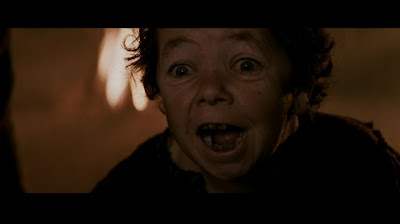 Mary, the mother of Jesus, awakes from what seems to be a nightmare. Mary Magdelene is concerned and asks whether Mary is all right. Mary, instinctively knowing something is wrong, responds by quoting from the prayers of Passover, "Why is this night different than other nights?" Mary Magdalene responds, "Because once we were slaves and we are slaves no longer." Suddenly John bursts in, telling them both that Jesus has been arrested.
 As Jesus is being taken to the palace of Caiaphas, he is beaten with his chains and is repeatedly beaten about the face, leaving one eye swollen shut. Judas is sitting under a bridge when Jesus is thrown over it by the Temple guards. Judas looks on with agony and shame. A demon appears from out of the air and sends a terrified Judas running away.

At the temple, Jesus sees Mary, Magdelene, and John. Jesus then recalls a tender memory of building a table for a rich man (possibly Joseph of Arimathea) and joking about it with his mother. We then cut back to Jesus standing before the Sanhedrin, including Caiaphas. Mary, Mary Magdelene, Peter, John, and Judas watch from afar as the temple priests denounce every doctrine that Jesus has taught, including that he is the King of the Jews, and the events of the Last Supper. Jesus is asked if these accusations are true, and He says yes, declaring further that they will see him sitting at the right hand of the Father. Horrified by Jesus's "blasphemy", Caiaphas tears his garments and screams in frustration. The infuriated priests beat Jesus and spit in his face. Jesus is then condemned to death.
 A horrified Peter attempts to flee, but is seized by several people who point out that he is a disciple of Jesus. Peter denies it each of the three times it is pointed out. As Jesus turns around and bores into him with his uninjured eye, Peter is overwhelmed with guilt and shame. When the Virgin Mary attempts to comfort him, Peter flees, crying that he is unworthy and bewailing what he has done. Judas goes to Caiaphas and pleads with him to release Jesus and take back the money. However, Caiaphas refuses to take it back, declaring that if Judas thinks he has betrayed innocent blood, it is his problem. Judas angrily throws the money on the Temple floor and runs off grief-stricken. As he sits by a fire, two children approach him and ask him what's wrong. When Judas curses them, they turn into demons. They chase Judas, tormenting him as he flees outside the city walls (Satan is visible among them). After they disappear, Judas finds a dead donkey being devoured by maggots. Overwhelmed with despair and unable to live with his shame, Judas takes the rope which was on the donkey and hangs himself from a tree.
 Meanwhile, the Temple priests bring Jesus to the court of Pontius Pilate, so that he may be crucified under Roman Law. Pilate angrily demands to know whether they always punish their prisoners before they are tried. After Caiaphas responds that Jesus has declared himself the Messiah, Pontius privately examines him. He offers Jesus a goblet of wine, but Jesus, having vowed to no longer drink the fruit of the vine at the Last Supper, politely declines. Pilate asks whether He is the King of the Jews. Jesus responds that his kingdom is not of this world and that if it were, His servants would never have allowed him to be handed over to his enemies. He further declares that all who hear the truth hear his voice. Pilate cynically retorts, "What is truth?"
 Pilate returns to the crowd, tells them that he finds no crime in Jesus and orders the priests to bring him before King Herod Antipas, because Jesus is a Nazarene, and thus one of Herod's subjects. Caiaphas angrily protests but grudgingly obeys. Herod is an effeminate bisexual, deeply impressed by reports of Jesus's miracles. When Jesus remains silent and will not respond to his pleas to work "a little miracle for me", Herod mocks him, laughing that Jesus is just "crazy." When the priests return him to Pilate, he is not pleased. He forces Caiaphas to choose between the release of a "notorious murderer" named Barabbas and clemency for Jesus. Caiaphas cries "Release Barabbas!"
  Pilate asks them what they feel a fair punishment would be, and the crowd, bribed by the Temple priests, scream out "Crucify him!" Pilate refuses, fearing that Jesus's followers will revolt and that the ensuing bloodshed will turn the Emperor against him. Instead, he orders Jesus to be flogged, hoping that the sight will make Caiaphas and the Sanhedrin reconsider their desire for the death penalty.
 Jesus is shackled to a broken pillar. Two Roman soldiers are to carry out the flagellation. They each pick up wooden switches and commence striking Jesus on the back. He is bruised, bloodied, and beaten, and sinks to his knees. Mary, Mary Magdelene, and John all watch, utterly shattered. To everyone's astonishment, Jesus wills himself back to his feet, even after the beating has exhausted the guards. They angrily put down the rods and each pick up a barbed scourge and continue. Jesus' flesh is further mutilated to the point where his left rib cage is visible. He seems on the brink of death before Abenader, the centurion who will later become St. Ctesiphon, angrily orders the flogging to cease, saying that they were not authorized to scourge him to death. The soldiers grudgingly put down their whips and release Jesus, having to drag him away because his agony is too great.
 The Virgin Mary and Mary Magdelene are presented with linen towels by Claudia Procles, Pilate's wife, who is just as crushed as they over what has just happened. They both go down to the courtyard and begin mopping the blood with the linen. Magdelene weeps as she remembers how Jesus saved her once from being stoned to death when she was still a sinner.
 Jesus is seen in a barn-like room, sitting against a wooden post. The two Roman soldiers who flogged him drive a crown of thorns into his scalp and spit on him. He is given a red soldier's cloak and mockingly treated with royal homage. "Hail, King of the Worms", laughs one of the guards as he bows. Jesus is then brought back to Pontius Pilate who is disgusted by how badly beaten Jesus is. He asks the rioting crowds if they are satisfied, but Caiaphas still demands that Jesus be crucified. Pilate disgustedly washes his hands of the whole affair and declares, "I am innocent of this man's blood." He orders Abenader to do as Caiaphas demands.
 We then see Jesus walking between two other criminals sentenced to the same fate He is. The two beside him are tied only to their cross' uprights -- Jesus must carry his own huge cross. Jesus embraces his cross, prompting mockery from one of the thieves. As He carries it through the streets, He is endlessly beaten and yelled at by the crowds and the Roman soldiers alike. Mary, Mary Magdelene, and St. John follow him.
 While struggling down a small alleyway, Jesus trips and falls with the cross. The cross crushes him, Mary runs to her son, flashing back to a time when he fell as a small child. As she reaches him she tries to comfort him, saying, "I'm here." Jesus looks at her, and wills himself to his feet to carry his cross, and, quoting the Book of Revelation 21: 5 declares "Behold, Mother, I make all things new." He rises to his feet and continues on his way. As Jesus keeps walking, He continues to fall under the weight of the heavy cross. The guards mock him and whip him each time. Abenader approaches again and, noting how weak Jesus has become, orders the soldiers to help Jesus carry the cross. Instead of doing this themselves, they find a man in the crowds, Simon of Cyrene, to help. He grudgingly agrees to help.

As the two keep going, Jesus falls without the cross. Simon is shocked at the weight which he cannot carry by himself. A riot breaks out, with groups of people fighting to get a chance at beating Jesus. Guards fight them off, and as that happens, Veronica approaches Jesus with a cloth and a pitcher of water. Jesus uses the cloth to wipe his bloodied face. However, as he goes to take a drink, a soldier walks over and kicks the cup over, and drives Veronica away. As the procession continues the viewer sees that Veronica's Veil has been imprinted with the image of his face.  While the soldiers continue to beat Jesus with whips, Simon angrily threatens to not help with the cross if they do not cease their beatings. They scornfully call him "Jew", but they oblige. The procession continues, headed for Golgotha, or "The Place of the Skull."

 Once there, Simon is ordered to leave. As he is driven away, he looks into Jesus's one open eye with love and pity. We see Mary, Mary Magdelene and John again. They all watch as Jesus is stretched onto the cross. They nail both of his hands, dislocating his right arm in order to make his hand reach the pre-drilled hole for the nail. In the midst of his agony, Jesus prays for mercy for all the sinners of the world, crying "Forgive them, Father. They know not what they do..." They then bind and nail his feet. They flip the cross over on Jesus' front side, however, Jesus is elevated off the ground. After pounding the tips of the nails down, the guards then flip the cross back over and raise it. As the cross is raised, we are taken to a flashback of the Last Supper, considered by Christians to be the first Eucharist. We watch as Jesus elevates the Host.
  On the cross, he is mocked by Caiaphas and the Temple priests, and by the thief to his right, who tells him to save them all if he is truly the Son of God. Jesus prays, "Father forgive them, they know not what they do." The thief on his right tells Caiaphas, "Listen, He prays for you." The Good Thief then tells Jesus his punishment is just, and that Jesus would be justified in condemning him, but he says, "Lord, remember me when I come into your Kingdom." Jesus tells the thief "On this day, you will be with me in paradise." As the other thief cackles with laughter over this, a crow comes from the sky and plucks at his face.
 Jesus grows weaker; simultaneously, the skies are turning darker. Mary and John approach Jesus on his cross. Jesus declares, "I thirst!" A sympathetic Roman soldier named Cassius, later to become St. Longinus, puts a sponge on a spear and soaks it in, according to the Bible, vinegar (although whether this is water or vinegar is not specified in the film). Jesus tastes it and then turns his head aside. The Virgin Mary pleads with Jesus to let her die with him. Jesus then tells Mary that John will now take care of her, and tells John that Mary is now his mother. Jesus then cries out in Aramaic, quoting the twenty-second Psalm, "My God! My God! Why have you forsaken me?" ("Eli, eli, lamai sabactani?") Jesus then looks down upon them, saying, "It is completed." Mary Magdelene weeps. Jesus then looks upward and gasps "Father, into your hands I commend my spirit." The pupil of his one open eye dilates, and he exhales his last breath.
  God then cries a tear that creates a violent earthquake. All the spectators of the crucifixion flee, and the soldiers are ordered to break the criminals' legs, in order to hasten their deaths. The Roman soldier Cassius breaks the legs of the thieves to Jesus' sides, but when he comes to break Jesus' legs, there is another tremble from the Earth. He tells Abenader that Jesus is already dead. Abenader orders him to make sure. Cassius then drives a lance into Jesus's side. Blood and water pour from the wound as Cassius falls to his knees. It is at this moment that everyone, Romans and Jews alike, realize they have indeed killed the Son of God. Meanwhile, back at the temple, the earthquake has shattered it in half and the Holy of Holies is revealed. Caiaphas, stricken with horror and shock, begins to weep.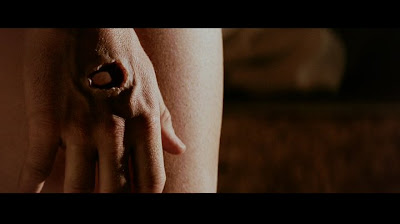
 We are then shown the interior of his tomb three days later, on Easter Sunday. We hear a rock rolling and as the morning light slowly streams into the interior, we see Jesus resurrected and his scourging wounds healed. He opens his eyes and stands up, and we see the hole in his hand from the nail. He walks out of his tomb to triumphant music, and there are no credits.
Etiquetas:
Find the truth